
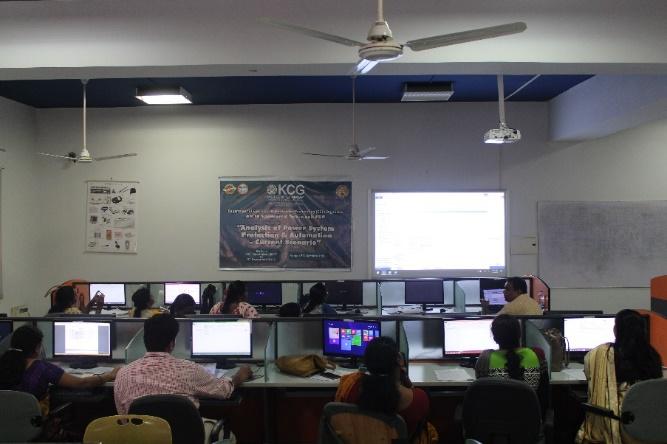
The Department of Electrical and Electronics Engineering, KCG College of Technology organized Two Week Faculty Development Programme on Analysis of Power System Protection And Automation- Current Scenario from 26th November – 9th December, 2017.
The inaugural function commenced at 9.00 am in Seminar Hall-I. The meeting began with an invocation and welcome address by Dr. P. DeivaSundari, Professor & Head, Department of EEE. The The meeting was presided by Dr. G. Prabhakaran, Principal. He congratulated the Department of EEE for hosting such FDPs in association with industries and offered his felicitations. Dr. G. Sambandan, Advisor – Electrical Sciences also addressed the gathering stating the significance of the topic in current scenario. Around 65 participants registered for the programme.The participants mostly were Faculty and Research Scholars from major academic institutions in and around Tamilnadu.
The programme was inaugurated by the Chief Guest, Mr A. Panchalingam, Chief Engineer, Protection and Communication, Tamilnadu Transmission Corporation Limited (TANTRANSCO), Chennai. He shared his views regarding basic protection schemes and recent advancements in protection. He also enlightenened the gathering with the concept of digital substation. The guest of honour, Mr. Balaji Seshadri, Lead Commissioning Specialist, General Electric, Chennai shared his views on power sector growth.
Day 1
Date: 26.11.2017
Session I & II: Power Protection Test Equipment Demo
Venue: Seminar Hall (F14)
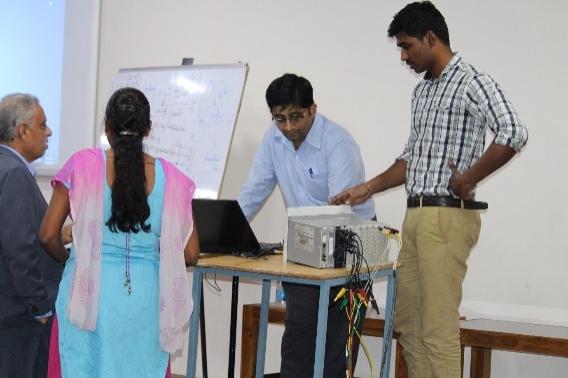
The fundamentals of Power System Protection, and transformer differential protection was discussed in detail. Differential protection of transformer using P642 numerical relay and OMICRON was demonstrated to the participants.
Day 2
Date: 27.11.2017
Session I: Fundamentals of Power System Protection
Speaker: Dr.Mahendra V Chilukuri, Associate Professor, School of Electrical Engineering, VIT University, Vellore
Venue: Seminar Hall (F14)
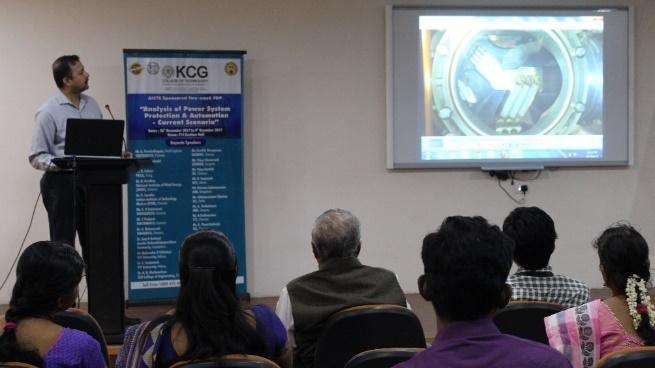
Dr.Chilukuri discussed the various protection characterstics and protection zones in power system. He explained the various types of protection relays. He showed the practical aspects of protection with a comparative study in Malaysian power system.
Session II: Main and Back-up Protection
Speaker: Dr.Mahendra V Chilukuri, Associate Professor, School of Electrical Engineering, VIT University,Vellore
Venue: Seminar Hall (F14)
The session started with the basics of current transformer and potential transformer highlighting the various protection related terms like CT error, CT saturation. The session continued with optical instrument transducer.
Session III: Grid Transformers Protection
Speaker: Dr.Mahendra V Chilukuri, Associate Professor, School of Electrical Engineering, VIT University, Vellore
Venue: Seminar Hall (F14)
The speaker had discussion on various relay characteristics and working of various types of relays. He explained in detail the working of static relays, numerical relays and features of relays used in protection of grid transformers.
Day 3
Date: 28.11.2017
Session I: Transformer, Generator and Motor Protection
Speaker: Dr.Mahendra V Chilukuri, Associate Professor, School of Electrical Engineering, VIT University, Vellore
Venue: Seminar Hall (F14)
The session started with principles of unit protection. He explained in detail the biased differential current relay for the protection of generators and motors. He emphasised on transformer inrush phenomenon. The conditional monitoring of transformers which is one of the recent key research areas in power systems was also discussed.
Session II: Condition Monitoring and Asset Management – Partial Discharge Diagnosis Technique for Offline & Online Analysis
Speaker: Dr.S.Venkatesh Associate Professor, School of Electrical Engineering, VIT University, Vellore
Venue: Seminar Hall (F14)
Dr.S.Venkatesh discussed the importance of condition monitoring and asset management, the need for power engineers in this area for further research. The session also dealt with the need of testing of power apparatus. The discussion continued with basic principles of Partial Discharge (PD) and various voltage and current PD waveforms. The principle of Partial Discharge Detection Circuits and PD Analyser was also discussed.
Session III: Electric Arc Flash Analysis.
Speaker:Dr.Mahendra V Chilukuri, Associate Professor, School of Electrical Engineering, VIT University, Vellore
Venue: Seminar Hall (F14)
The session stared with basics of arc-flash phenomenon, its characteristics and the effects of arc-flash that lead to switchgear damage. The speaker also dealt with arc -lash measurement techniques and calculations. A case study on arc-flash helped the participants to have a practical exposure on arc-flash techniques.
Session IV: Non-intrusive Testing Techniques for Ageing/ Residual Life Assessment of Power Equipment Conventional & Non Conventional Approaches
Speaker: Dr.S.Venkatesh, Associate Professor, School of Electrical Engineering, VIT University
Venue: Seminar Hall (F14)
He enlightened the audience with the Electric Treeing and the Testing of PD Test Setup. He showed photographs of laboratory studies conducted at LIT- University of Bologna. Variety of analysis techniques applied on the data to extract characteristic information of PD was also discussed. The session continued with the discussion on classifiers for multiple source PD pattern recognition and types of on-line PD measurement system challenges related to online PD analysis.
Day 4
Date: 29.11.2017
Session I: Network Planning Using Advanced Power System Simulation Tool (Siemens Software)
Speaker: Mr. Vikas Chaturvedi, Maintenance and Support, Siemens, Gurgaon.
Venue: Seminar Hall (F14)
The session dealt with PSSE, the transmission planning software from Siemens. The challenges in expansion, operation, regulatory compliance, system reliability and security were discussed. Hosting capacity calculation, distribution network analysis by PSSSINCAL was discussed. The features along with the add on modules of the software was dealt in detail.
Session II: HVDC
Speaker: Dr. Mahendra V. Chilukuri, Associate Professor, School of Electrical Engineering, VIT University, Vellore
Venue: Seminar Hall (F14)
He discussed in detail the aspects of HVDC Technology. A comparative study of AC & DC Transmission and detailed discussion on worldwide HVDC links along with a schematic presentation of HVDC transmission system was done. This was followed by an informative session on HVDC applications in India. A schematic diagram of Converter Station was presented in the session.
Day 5
Date: 30.11.2017- Field Trip to Indira Gandhi Centre for Atomic Research (IGCAR), Kalpakkam.
A visit to Simulating and Training Centre, Fast Breeder Test Reactor at IGCAR was made. At simulating centre, the entire process was simulated using C and Fortran and the mock control panel has been created for training the operators. This centre simulates the control panel of 500 MW Prototype Fast Breeder Reactor.
The Fast Breeder Test Reactor (FBTR) is a breeder reactor of 40 MW capacity. The Indira Gandhi Center for Atomic Research (IGCAR) and Bhabha Atomic Research Centre (BARC) jointly designed, constructed and operate the reactor. The reactor was designed to produce 40 MW of thermal power and 13.2 MW of electrical power. It is called Stage-II reactor because its fuel plutonium carbide is extracted from irradiated fuel from MAPS (Madras Atomic Power Station) reactors, which in turn called Stage-I reactors, whose main fuel is Uranium 235 and Uranium 238.
Day 6
Date: 01.12.2017
Session I: Grid Integration of Renewable energy and related Issues
Speaker: Dr. Sasi K Kottayil, Professor, Electrical and Electronics Engineering, Amrita VishwaVidhyapeetham University, Coimbatore.
Venue: Seminar Hall (F14)
The session started with discussion on net metering system with small grid-tied PV without storage and PV with dual mode inverter and storage. The various aspects of medium and large sized grid connected PV system and RE based smart micro grid was dealt in the session. The various wind turbine driven electrical machines like wind turbine driven squirrel cage induction generators, permanent magnet synchronous generators and variable speed induction generators was emphasized in the session. A new concept of smart solution for energy storage and demand dispatch was also given.
Session II : Issues & Control of Grid integrated Renewable Energy Systems
Speaker: Mr. Prasun Kumar Das Assistant Director, NIWE, Chennai
Venue: Seminar Hall (F14)
He emphasized on concepts of Solar Radiation Resource Assessment (SRRA) and gave a schematic representation of typical SRRA station. The basic principle of solar cell principle, losses in solar cell and different types of solar modules and its characteristics were discussed in the session. Latest topics of research such as losses in grid connected system and grid integration issues also were discussed.
Session III : UHV Transmission
Speaker: Dr.R.Sarathi, Professor, Department of Electrical Engineering, IITM, Chennai
Venue: Seminar Hall (F14)
The session started with need for UHV transmission system and the various challenges in UHV AC system. He dealt in detail the various Temporary Over Voltages (TOV), Slow Front or Switching Over Voltages (SFOV), Fast Front Over Voltages (Lightning Over Voltages) and Very Fast Transient Over Voltages (VFTO). The general principle of insulation coordination and various methods of determination of the system voltage stress were discussed under insulation coordination.
Day 7
Date: 02.12.2017
Session I: Overview of Blackouts – Lessons to be Learnt
Speaker: Dr. G. Sambandan, Advisor-Electrical Sciences, KCG College of Technology
Venue: Seminar Hall (F14)
The session dealt with the overview of blackouts, major global blackouts, blackouts in India, the twelve biggest blackouts in history, the reasons for blackouts and the lessons to be learnt. The session was stimulating with questions from participants and the real time examples that Dr.G.Sambandan shared from his experience.
The Hour of Code began as a one-hour coding challenge to give students a fun-filled introduction to computer science and has become a global learning, celebration, and awareness event. It takes place every year during Computer Science Education Week, the first week in December (4th to 10th). With such a huge groundswell of support and attention, it’s an ideal time for schools and districts to put the spotlight on computer science programs and expand opportunities. The Hour of Code is at its core not about learning a brand new skill in just one hour. One hour isn’t enough to learn how to code. It’s about increasing access to computer science by breaking stereotypes and opening doors. Somebody may learn programming concepts like loops, conditionals, or basic debugging through the Hour of Code. But a much more important goal is for students and teachers to learn that computer science is fun.
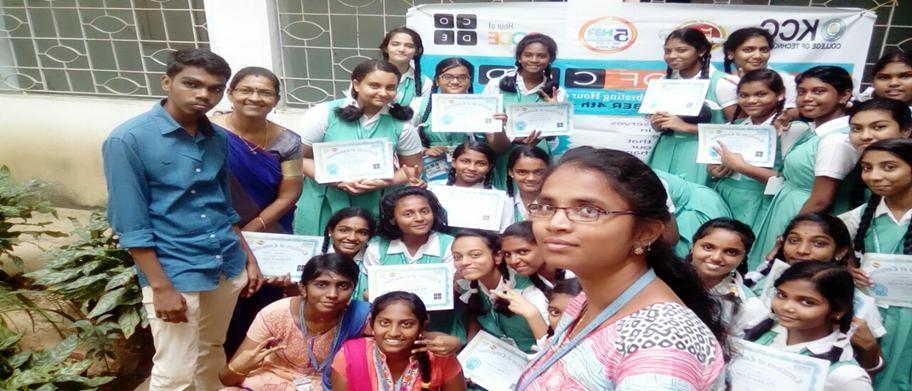
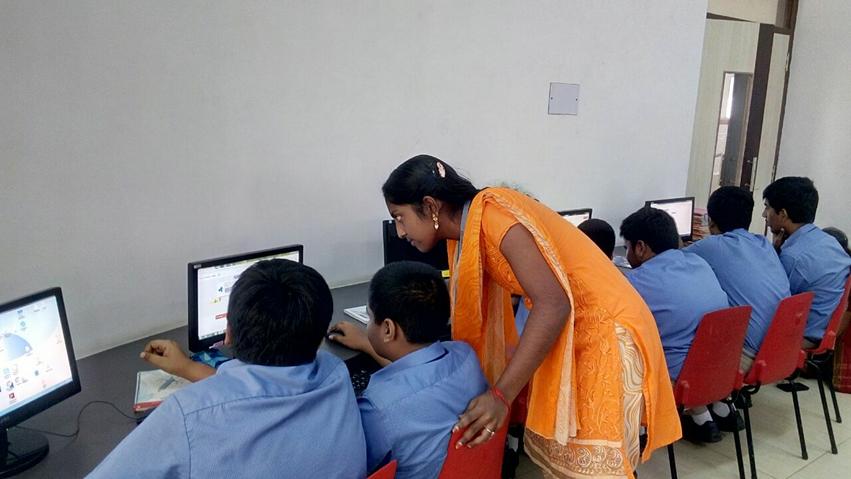
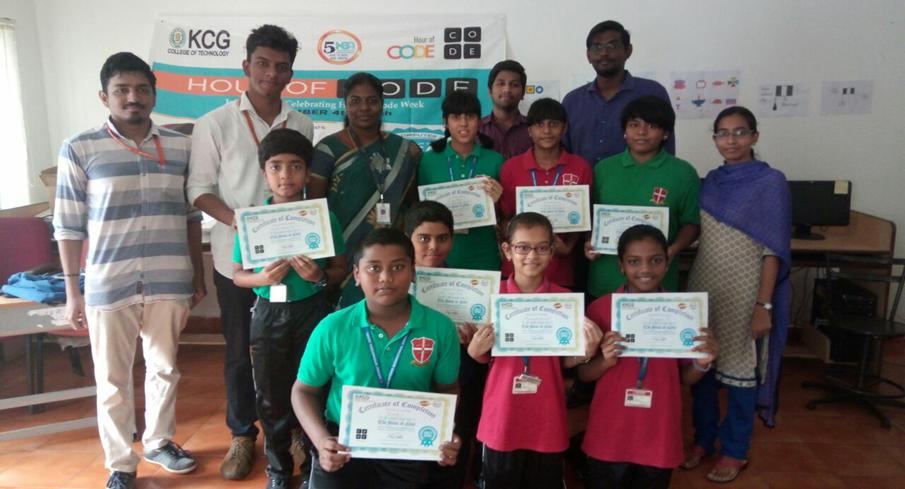
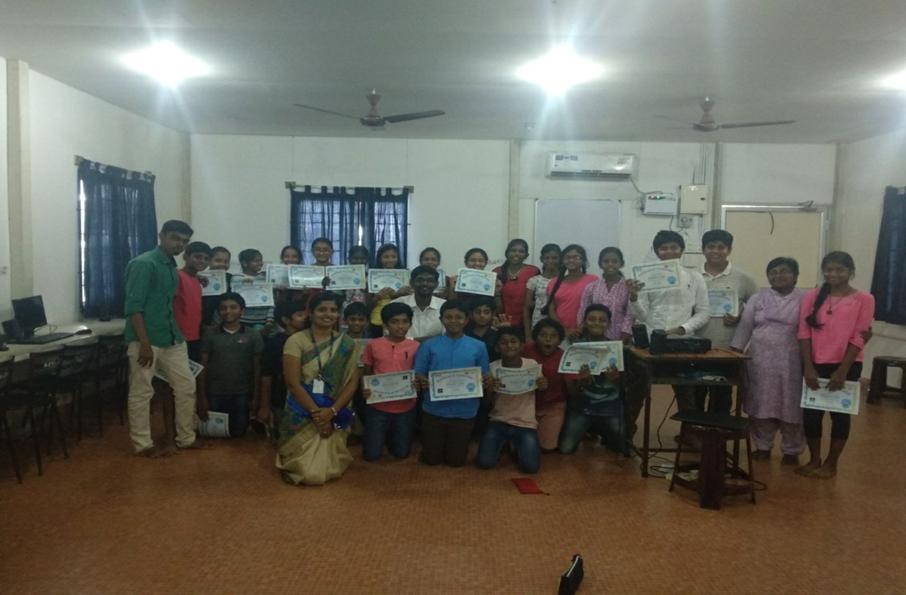
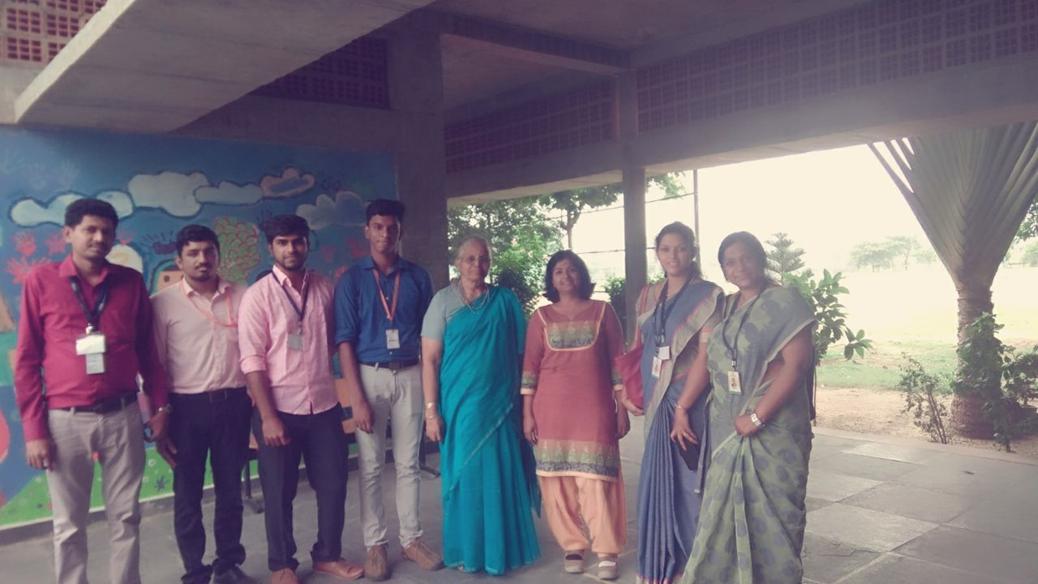
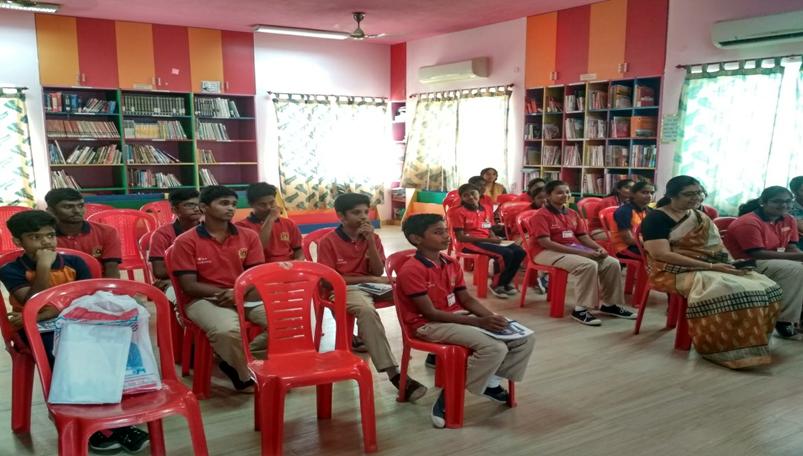
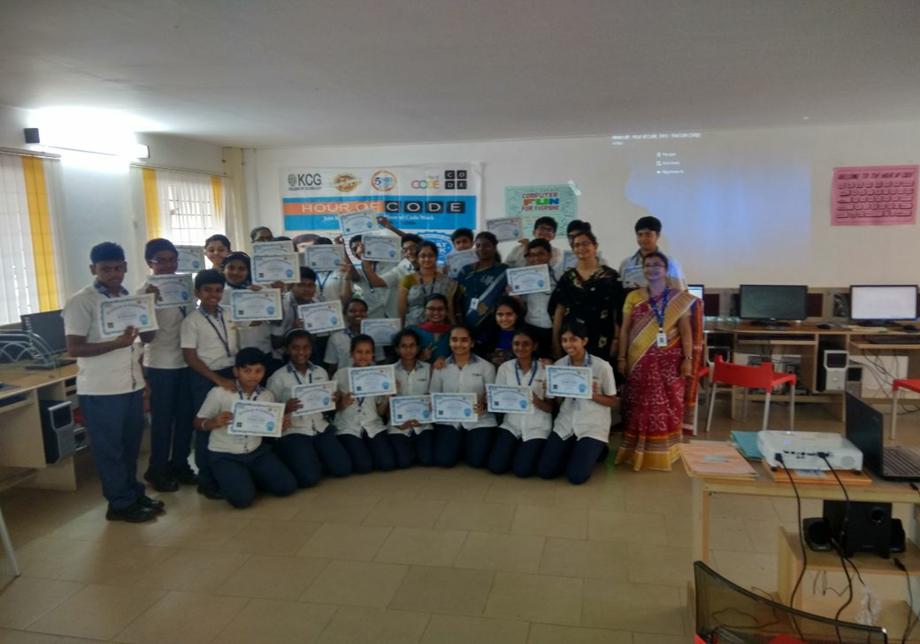
As a part of social outreach programme, KCG College of Technology had organized the Hour of Code in 11 schools around in Chennai. A team of 9 Faculty from CSE and IT departments along with 15 student volunteers from various departments conducted the programme from Dec 4th to 10th. Around 299 students from 11 schools (13 batches) participated in the programme. They practiced Blockly and Minecraft in one hour.
Programme Objectives:
- Introduce school children to computer science in an interesting way.
- Helps to improve the computational thinking skills in an approachable way.
- Students will identify the pros and cons of self-directed learning as it relates to learning code.
Participants:
A set of 15-30 studentsof grade 7 and above participated in a session.
Schedule:
|
School Name |
Number of students |
Time |
Date |
Faculty Coordinators |
|
|
1 |
Good Earth School, Tambaram |
21 |
12.00 to1.00pm |
4.12.17 |
Ms. Anju A |
|
25 |
2.00 to 3.00 pm |
||||
|
2 |
Gateway International School,ECR |
6 |
9 to 10 am |
6.12.17 |
Adline Freeda/ Ms.krithikaa |
|
10 |
10 to 11 am |
||||
|
3 |
Union Christian School, Kilpauk |
20 |
9 to 10.00 am |
5.12.17 |
Ms.Minu Thomas/ Ms.Soumya |
|
4 |
San Academy,Velacherry |
16 |
10 to 11 am |
9.12.17 |
Ms. Anju A |
|
5 |
Hindustan International School, Guindy |
16 |
1.30 to 2.30pm |
4.12.17 |
Ms.Soumya/ |
|
6 |
Don Bosco |
29 |
10.30 to 11.30 am |
6.12.17 |
Dr. Poonkavithai |
|
32 |
11.30 to 12.30 pm |
||||
|
7 |
Hindustan International School, ,Karapakkam |
24 |
2.00 to 3.00 pm |
6.12.17 |
Ms.krithikaa/ Ms.AdlineFreeda |
|
8 |
Hindustan International School,Padur |
25 |
2.00 to 3.00 pm |
6.12.17 |
Mr.MBaskar/ Ms.Minju |
|
9 |
Headstart Learning Centre,Thalambur |
27 |
11.00 am to 12.00 pm |
7.12.17 |
Dr. R. Anand/ Ms.Minu Thomas/ Ms.Minju |
|
10 |
CSI Jessiemoses,Anna Nagar |
21 |
2.00 pm to 3.00 pm |
7.12.17 |
Dr. Poonkavithai |
|
11 |
Spartan Matric Secondary School,Mogappair East |
27 |
2.00 pm to 3.00 pm |
5.12.17 |
Ms.Minju |
List of student volunteers:
|
S.No |
Name |
Department |
|
1 |
E.Samundeswari, M.Sivagami |
AERO (II Year) |
|
2 |
Jonadab Theodore Arun Kumar |
ECE (II Year) |
|
3 |
S.Daniel Arulanandam |
EEE(II Year ) |
|
4 |
Riya Paul Sahana Sriram Smriti Porwal Aiswarya.S Dinesh Kevin George A |
CSE (II/III Year) |
|
5 |
Nishanth K.R Naveen K.T Keshav M |
IT (III Year) |


Feedback from School:
The overall feedback for the programme was very positive. Students enjoyed doing coding in one hour. Some of the feedbacks from schools were video recorded. Sample feedbacks are given below.
Students:Don Bosco Excellence
Volunteers Feedback
The volunteers of Hour of Code shared their experiences and what they have learned is compiled and given below
Dorai Thodla, Our mentor
1. Realized that kids do not need to be taught to build things and solve problems. I saw the difference between the performance of students who were assisted by teachers and who were not. Most of the time students who were allowed to explore on their own (and with their friends) did much better.
2. Working in groups is one of the best ways to explore and learn. In almost all the 4 schools I went to, I saw this happen.
3. If you give interesting, creative challenges, you can keep even very restless kids engaged.
Soumya S, Assistant professor,CSE
1. College students should be given a platform to get involved in such activities. It is a proud moment for the teachers to see our students gain respect. I realized that we need to teach more outside the classroom so that they come back and learn in the classroom.
2. “A person who feels appreciated will always do better than what is expected” This quote worked at many places, for our students, teachers and school kids.
Arunkumar, II year, ECE
I understood that I can do more than what I thought.I usually don’t speak much to strangers but through this I learned how to mingle with everyone, even strangers.I got many new friends, met new faculties and had an awesome experience with them.I am very much interested to do such activities in future. And I also realized kids now are more brilliant than us so we have to learn more than now.
Daniel,II year student,EEE
I have not guided anyone on anything,but I did it through Hoc. This is my first team work for a week and it was a great experience! I gained people from other departments including teachers. I am very proud to be a HOC’ian.
Smriti, III year, CSE
1. one thing about which I was very interested before going to first school was – how I am going to handle kids, how will I answer their smart questions quickly…I wanted to try myself… because this is something I think we are doing for the first time… pretty amazing
2. All the students were competitive; they made me to understand that there’s a long way to go. Confidence was amazing, probably something at times even we lack. I am a more confident person now.
3. it’s nice to hear- “mam”
Krithika,Assistant professor, IT
1. This takes me to my school memories,where they teach me these types of activities.(my generation missed it)
2. This was an awesome experience where i learnt a lot from our students. Throughout they were very energetic. Their leadership qualities are excellent,the way how they answer,how they treat each kid is something to be appreciated.
Jonadab Theodore,II year,ECE
Going back to my old school to volunteer was the best thing ever. My old teachers were more than ecstatic. Furthermore I met such brilliant kids,who were casually completing their works and having fun too. And whenever I had a conversation with them about coding or computers, their knowledge about general computer science is enormous.And most of all people actually thought I was an actual professor for my height and I felt accomplished more than anything. I still have goosebumps when I see the kids having fun while working on the hour. All in all a brilliant experience and itwas an honor to be a part of the HOC team.
Adline,Assistant professor,IT
HOC has given me great lessons. 1. Mingling in the society2. How to Organize an event outside the campus 3. The Dedication of our volunteers was commendable. The children were also amazing as they all started to explore the tools in their own way.We have to keep ourselves updated as these children are brilliant.
Sivagami, II year, AERO
Hoc event gave me
1. Confidence to open up to the young minds
2. Taught me to tackle and think laterally, and use my logics
3. Participate in an event outside campus n to extend my limits to reach
4. Wonderful vacation n memories for lyf tym
Riya paul,III year,CSE
Felt really proud of making students learn that computer science is fun and creative.And myself felt proud to be a computer science student. As I had aim of becoming a teacher, thanks to hoc for giving me a chance to teach kids. It taught me that how much a teacher must prepare before taking class. Coming generation is really smart. This could be seen by the questions they asked which made us to think for the answer .This took me to school memories where I wish even I got to participate in hoc. I just wish these brilliant kids are given the right guidance and right direction to shine in their life.
Minju, Assistant Professor CSE
Current and upcoming generations are really smart that we Teachers should update our knowledge frequently. As HOC said every child deserves to learn Computer Science.hoc experience gives me an insight that we can teach students those who are not good in programming through GUI games like Blockly.Also, participation is very important. I am very happy that I worked with students not only from cse.We must get opportunities like this than classroom learning.
Aishwarya, II year CSE
I love teaching especially teaching kids but never ever had such an experience.I Learnned how difficult it is to gain the attention of all the students. My shyness flew off, and I learnned leadership qualities. As a computer science student I’m happy that we spread the knowledge of computer science to kids. If these activities had been there when I was in school, I would have taken and studied CSE with even more interest. I think this can be called object oriented learning. Thank u to all who gave me this wonderful opportunity. Proud to be a part of this event.
Anju, Assistant professor, IT
This is my first outside campus activity. I Learned alot by interacting with new people.The Kids are extraordinary, what we are learning today, they already knew. Some of them without teachers help started exploring themselves. Great experience. I am very proud being a part of HoC.
Dr. Poonkavithai, Associate Professor,CSE
I strongly believe that we can learn from anybody. Hoc has given me an opportunity to learn from students outside CSE Dept. First and foremost we have to be a kcgian.Lesson1: Belongingness is important
I discovered that sometimes we should let go ourselves. Myself and Anju were frustrated that every school rejected us. And I was not physically fit also. We just decided to keep talking to the PA in spite of her saying principal is busy. Second Lesson learned:” Speak your heart. “
Lesson 3: Studentsthriveanywhere.Doesn’t need only international standards… Its dependent on person alone
Minu Thomas, Assistant Professor CSE
Hoc has proven that learning experiences involve no age limit and it guided us towards engagement in contents and helped us learn new skills. It took most of us back to our school memories and that helped us to volunteer in the same level of innocence. Also learned that teamwork will bring out the best skills of an individual in any circumstances.
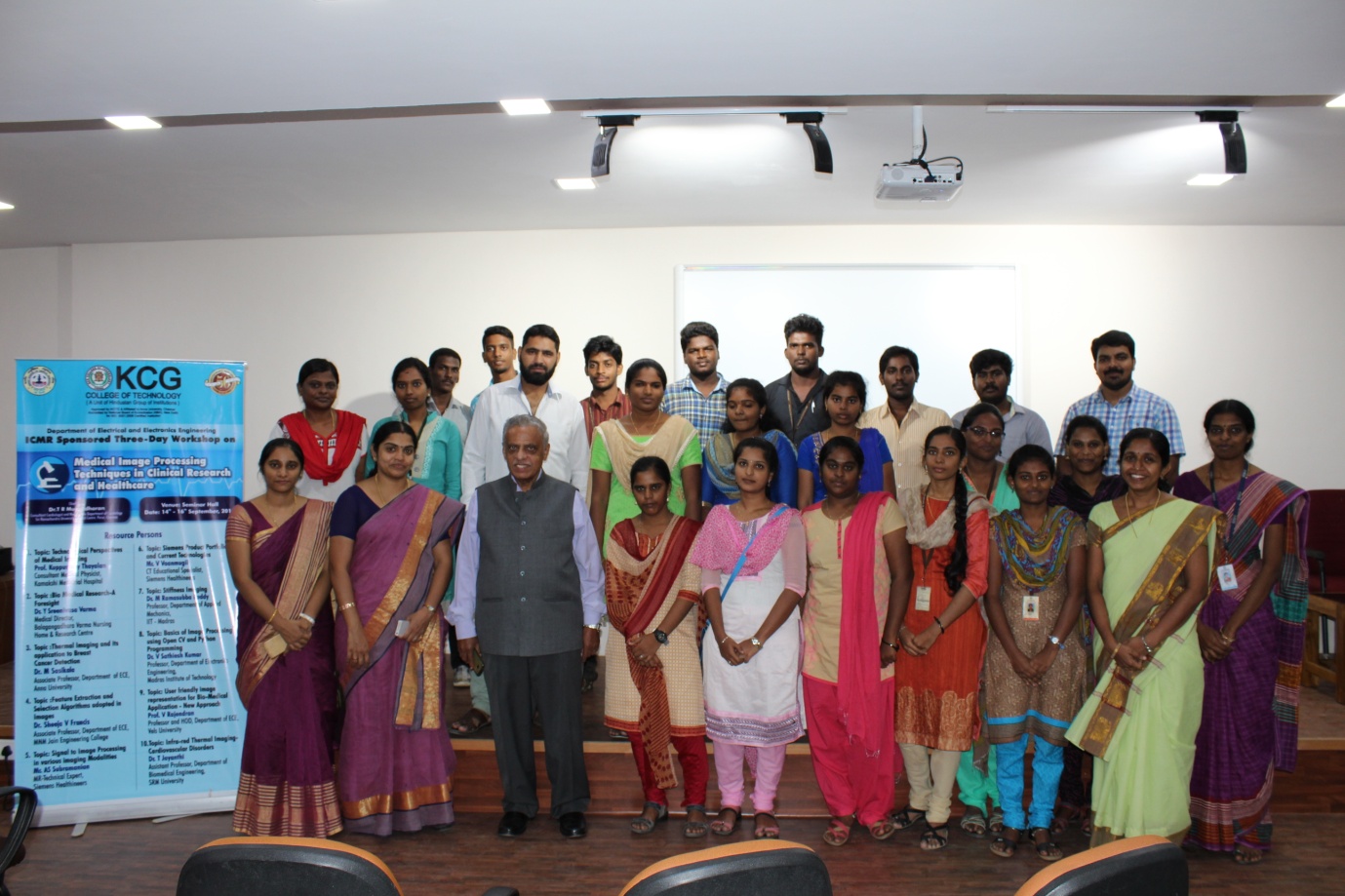
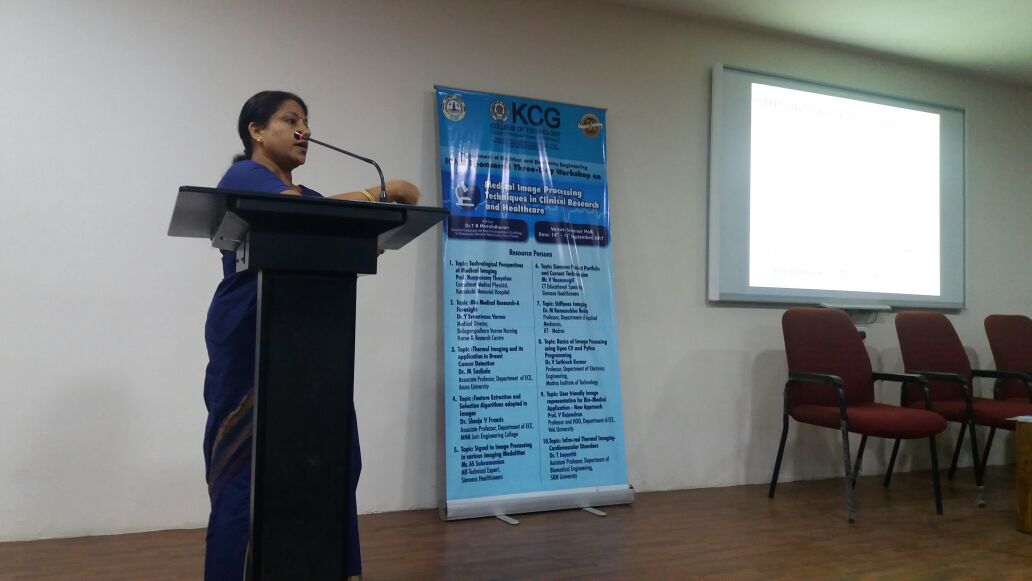
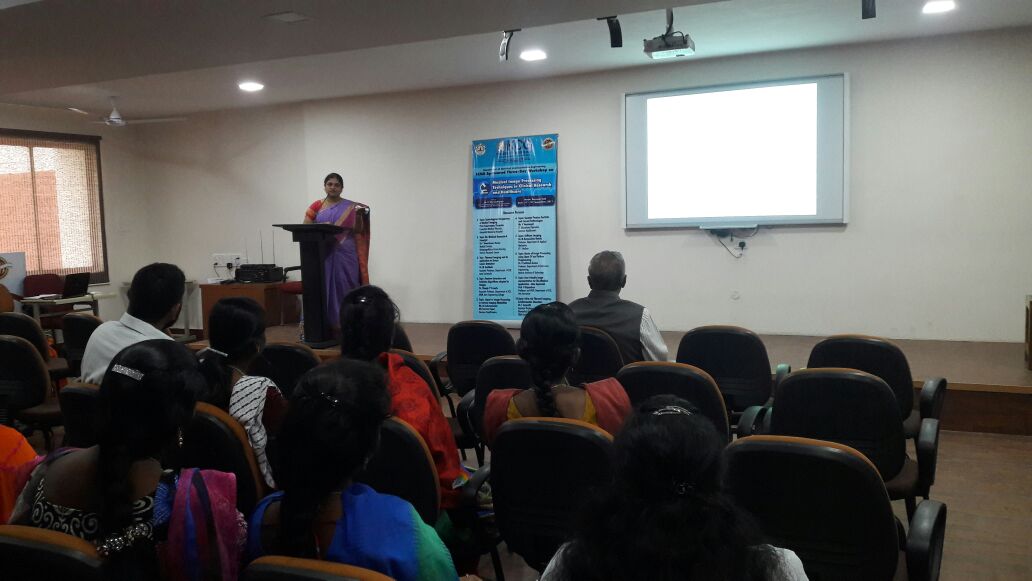
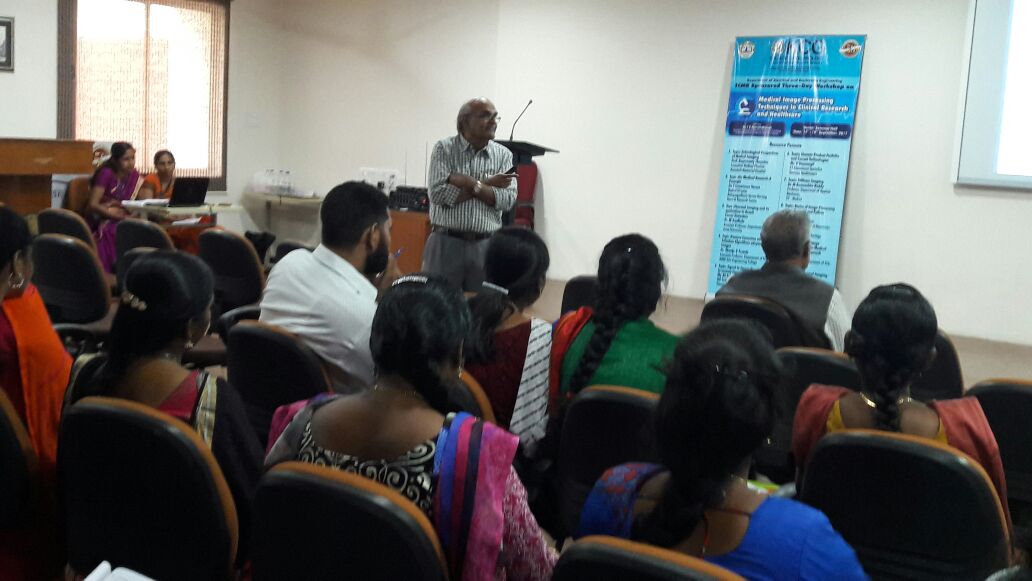
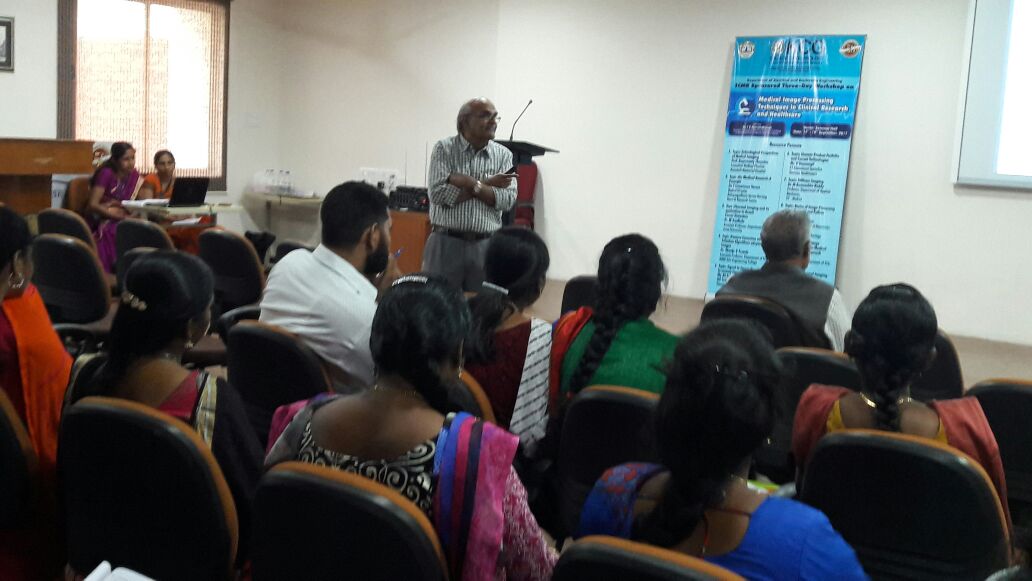
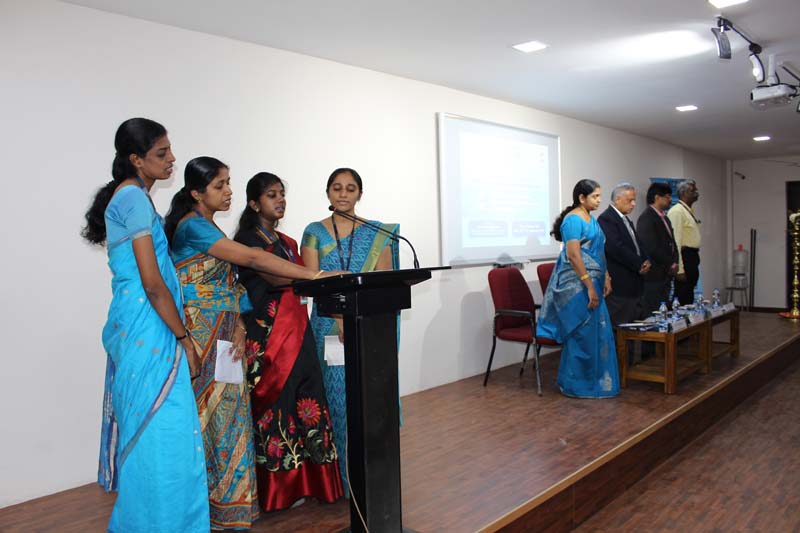
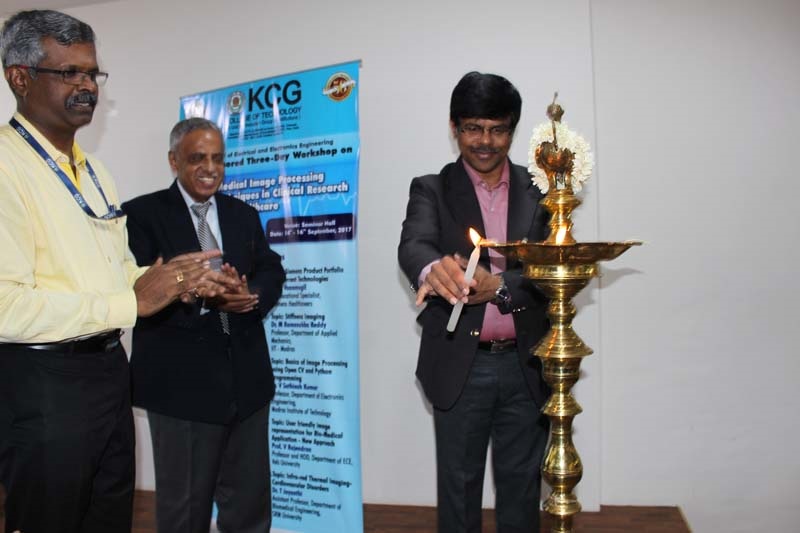
The Department of Electrical and Electronics Engineering, KCG College of Technology organized ICMR sponsored Three Day Workshop on “MEDICAL IMAGE PROCESSING TECHNIQUES IN CLINICAL RESEARCH AND HEALTH CARE” from 14th – 16th September 2017. The inaugural function commenced at 9.30 am in Seminar Hall-I. The meeting was presided over by Dr. G. Prabhakaran, Principal and inaugurated by the Chief Guest, Dr. T. R. Muralidharan, Senior Consultant and Head, Department of Cardiology, Sri Ramachandra University. The meeting formally begun with an invocation and the invited guests were welcomed by Dr. P. Deiva Sundari, Professor & Head, Department of EEE. . Dr. G. Prabhakaran, Principal and Dr. G. Sambandan, Advisor – Electrical Sciences offered felicitations. Around 25 participants registered for the programme. Most of the participants were Faculty from academic Institutions, Research Scholars, PG and UG students. The Chief Guest shared his views in the field of medical image processing and current research methodologies available.
The detailed report of the sessions are as follows:
Day 1 – Session 1
Ms. Prof. Kuppusamy Thayalan, Consultant Medical Physicist – Kamakshi Memorial Hospital
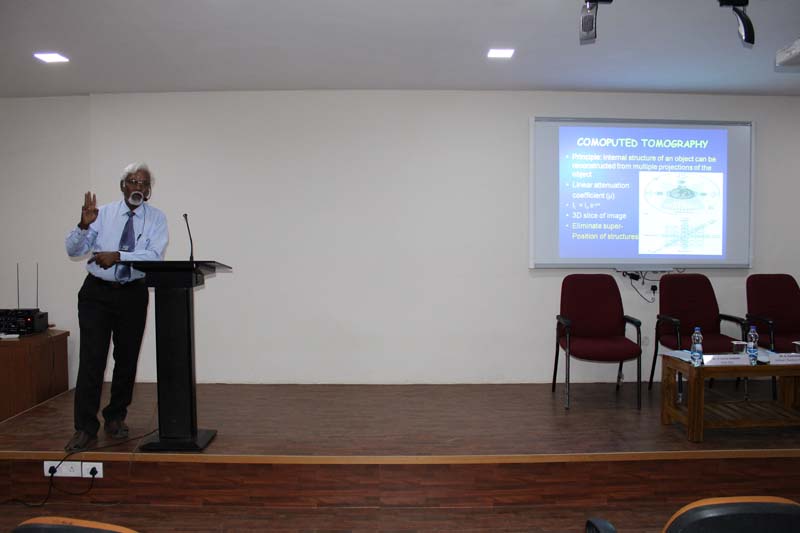
He introduced the technological perspectives of Medical Imaging. The development of modern radiographic imaging, the basic physical principles behind common approaches to imaging, including Computed Tomography (CT), Ultrasound, and Magnetic Resonance Imaging (MRI), and the pros and cons of each technique were explained by him. Students consider the broader picture behind bringing imaging into clinical use, such as animal testing, human trials, costs, and the requirement of training technicians. Medical imaging in general is rich with applications of engineering and physics because the instrumentation is technically complex. Many of the body’s systems and functions can be modelled, controlled, and investigated using engineering principles and methods. The instrumentation that is used to deliver health care is also very technical and rapidly evolving. As a result, engineering is becoming an increasingly important field of study in both biomedical research and medical delivery at all levels of the health-care system.
Session II
Dr. Y. Sreenivasa Varma, Medical Director, Balagangadhara Varma Nursing Home and Research Centre
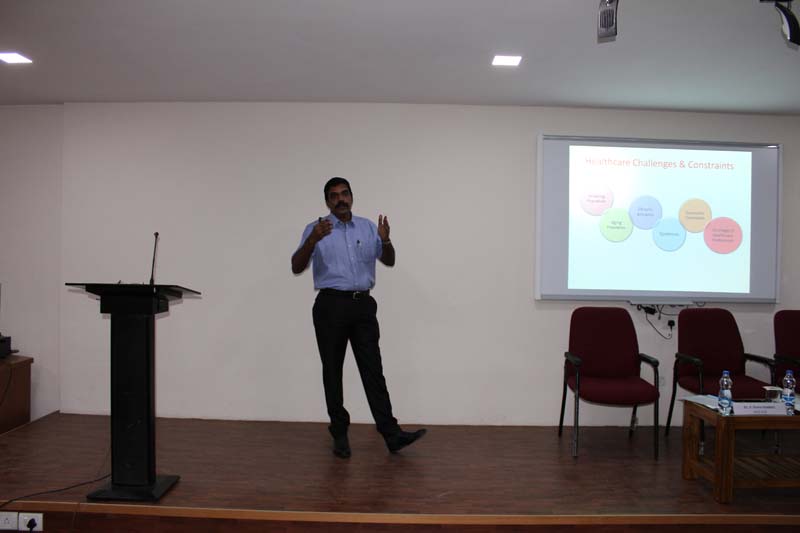
He started the session by stating the definition of health, health care challenges and constraints. He emphasized that technology is driving a new paradigm to create better healthcare. He focussed on the basic two approaches in medical innovation: Linear and Technology adoption approaches. He also focussed on the basic two approaches to medicine: Clinical and Molecular approaches. He mentioned that technology helps doctors’ to have better decision making, improving patient and provider interaction and integrating preventive health care tools as clinical reminders. He explained about the top trends in the areas of medical research like image and signal processing, bio medical sensors, IOT and Big data analytics, Artificial Intelligence, Genomics, stem cell therapy and tissue engineering. He explained the advancements in imaging techniques, bio sensors, bio sensing wearables, health care big data challenges.
Session III
Dr. M. Sasikala, Associate Professor, Department of ECE, Anna University
She gave an idea about Thermal Imaging and its Applications to Breast Cancer Detection. Body temperature is a natural criterion for the diagnosis of diseases. Thermal imaging (thermograph) applies infrared method which is fast, non-invasive, and non-contact and flexible to monitor the temperature of the human body. Historically, temperature is a very good health indicator. Body produces heat and body temperature may be different from the surrounding temperature. The core temperature is maintained within a narrow range of about 33°C to 42°C. Abnormal thermal patterns can be easily detected by thermal imaging. The results of thermal measurement in general compared with other clinical findings to assess the possible correlation. Although the method is non-specific and environment can affect its results, there are several reasons which have caused thermal imaging to be accepted widely among the medical community. First of all, thermal imaging is noncontact, non-invasive method and can be used from far way.
She explained about the different image processing techniques used in thermo graphic images for breast cancer detection. The different thermo graphic image patterns for the normal and abnormal portion of the body were shown. The features to identify the abnormality were also clearly explained.
Session IV
Dr. Sheeja V Francis, Associate Professor, Department of ECE, MNM Jain Engineering College.
Her topic was Feature Extraction and Selection Algorithms adopted in Images. She summarised various ways of performing dimensionality reduction on high-dimensional microarray data. Many different feature selection and feature extraction methods exist and they are being widely used in clinical and health care systems. All these methods aim to remove redundant and irrelevant features so that classification of new instances will be more accurate. A popular source of data is microarrays, a biological platform for gathering gene expressions. Analysing microarrays can be difficult due to the size of the data they provide. In addition the complicated relations among the different genes make analysis more difficult and removing excess features can improve the quality of the results. She presented some of the most popular methods for selecting significant features and provides a comparison between them. Their advantages and disadvantages are outlined in order to provide a clearer idea of when to use each one of them for saving computational time and resources.
Day –II
Session V: Prof. V. Rajendran, Professor and Head, Department of ECE, Vels University
He addressed the importance of detecting the presence of solid deposit of calcium radicals grouped in certain way in breast tissue. He explained the principles of digital images and analysis of digital imaging processing operation. He explained a case study done titled automated simulation model using CAD techniques, Analysis on cyst using sonomammogram. He explained novel automated algorithm using CAD Technique to find 3D pattern recognition of lesion part using physical characteristics.
Session VI: Dr. T. Jayanthi, Assistant Professor, Department of Bio Medical Engineering, SRM University
She explained about Infra-Red Thermal Imaging for cardio vascular disorders. She discussed in detail about the following:
- Prevalence of CVD
- Standard Diagnostic Methods
- Infrared thermal imaging
- Potential of IR in diagnosing CVD
- Static thermal imaging
- Dynamic thermal imaging
- IR and hypertension
- IR and its scope for research
Session VII & VIII:
Mr. AS Subramanian & Mr. V. Vaanmugil, Siemens Healthineers
Mr.AS Subramanian explained about the different imaging equipments available from the earlier days to the recent ones. He also gave a detailed idea about how these equipments are used.
Mr.Vaanmugil explained about the company portfolio and the recent equipments that are available with them.
|
Day –III Session IX: Dr V Sathiesh Kumar Professor, Department of Electronics Engineering, Madras Institute of Technology Basics of Imaging Processing using open CV and PYTHON Programming It was a Tutorial Session from 9 am to 12 noon on the basics of computer vision in Python programming. It included an introduction to Open CV, tutorial on image basics, drawing, basic operations on image resizing, masking, merging, kernels etc. and how it is been used in the image processing field.
Session X: Dr. M. Ramasubba Reddy Professor, Department of Applied Mechanics, IIT Madras. He gave a presentation related to Ultrasound Stiffness Imaging Techniques. He emphasized on basics of ultrasound imaging process. He explained with respect to diagnosis of lesions using ARFI Imaging. He explained about Manual palpation and method of Elastography. A detailed analysis of steps in Elastography was presented. He presented a case study with results from an experiment obtained from a tissue mimicking phantom. He briefed about the breast cancer diagnostic technique (X- Ray mammography) comparison of Elastography with ultrasound process.
|
Project e-Yantra is an initiative to spread education in embedded systems and Robotics by IIT Bombay sponsored by Ministry of Human Resource Development through the National Mission on Education through ICT (NMEICT). The objective of e-Yantra is to provide hands-on learning to engineering students, creating the next generation of engineers in India with a practical outlook to take on challenging problems and provide solutions.
KCG College of Technology is a member of e-Yantra and has set up a state of the art laboratory under the e-Yantra Lab Set-up Initiative (eLSI).The KCG e-Yantra Robotics Lab trains students in embedded systems and micro-controller programming by engaging them through the Project Based Learning (PBL) mode.
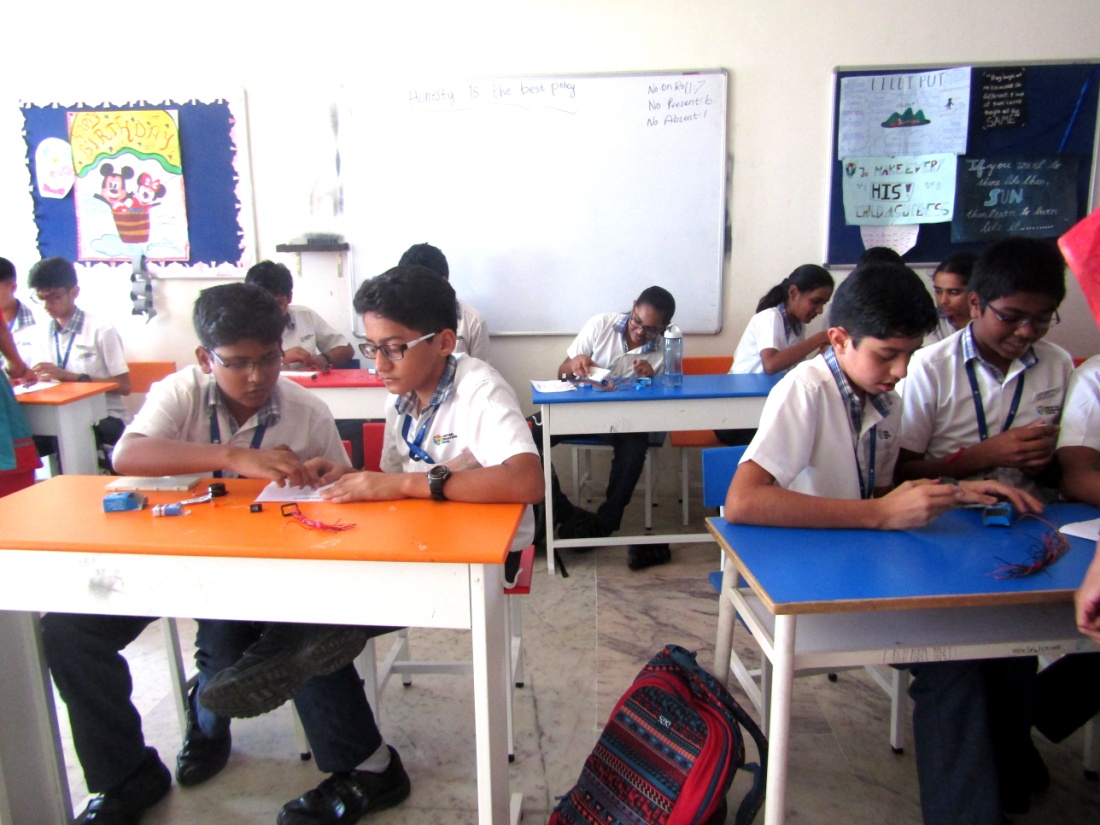
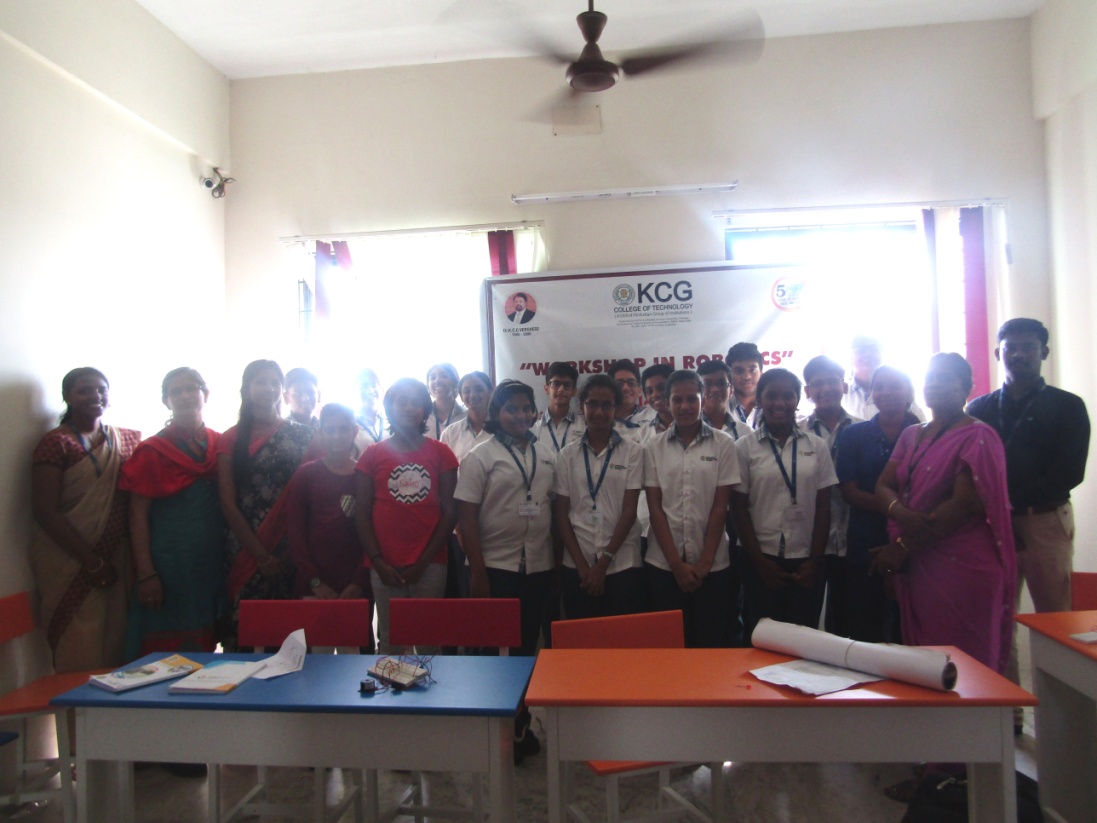
A Workshop in Robotics was conducted for the pupils of Hindustan International School, Karapakkam. The children were of different age group ranging from Grade 6 to Grade 9. It was conducted on 20 December 2017 for a session of 2 hours for 23 pupils. They showed immense pleasure in learning about Robots. A presentation on Robots and their varieties including its working were given. A few videos on the recent trends of Robots were played. A live demonstration on Firebird V was shown. Finally the children experienced a hands-on session of an LED glowing and a Buzzer beeping though Bread board connection.
The workshop was conducted by Aida Jones (Asst. Professor, ECE), Renganayaki G (Assoc. Professor, ECE), S. Subash Chandra Bharathi (Asst. Professor, EEE) and Feba Sosa Abraham (Asst. Professor, ECE).
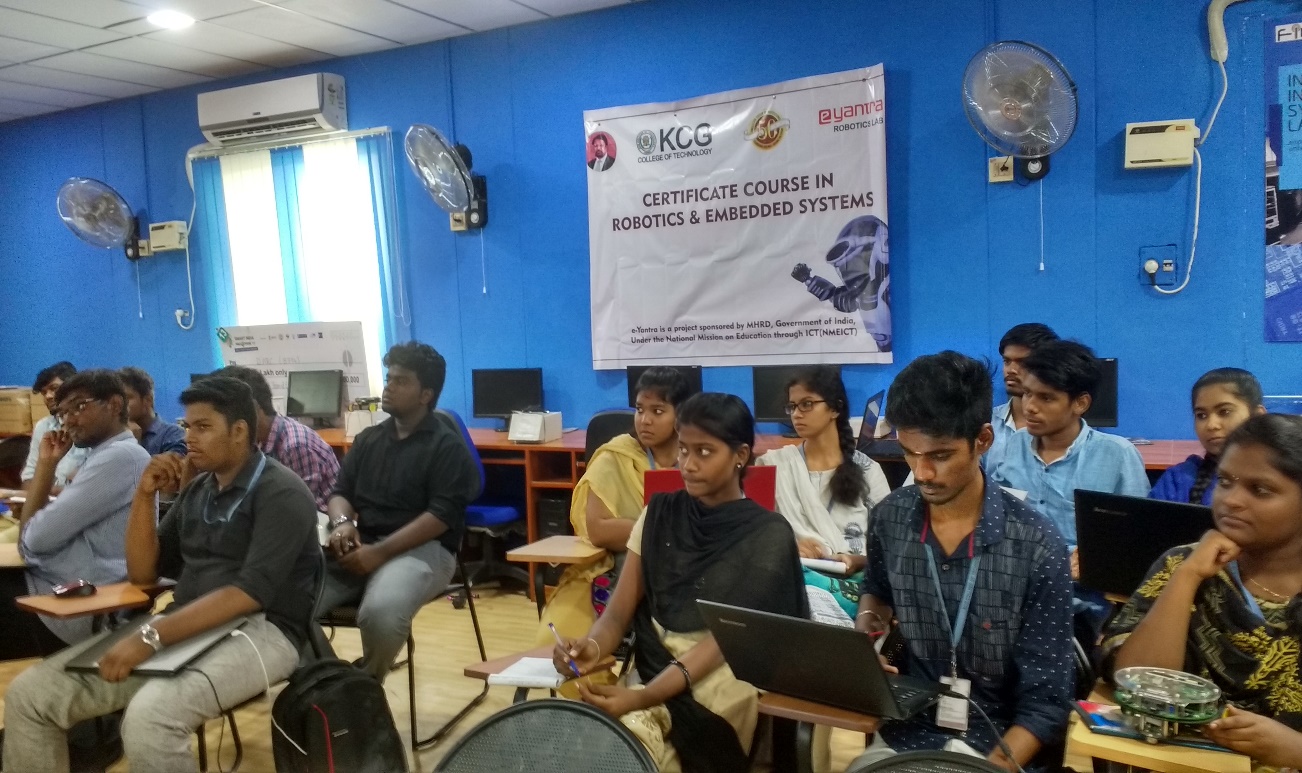
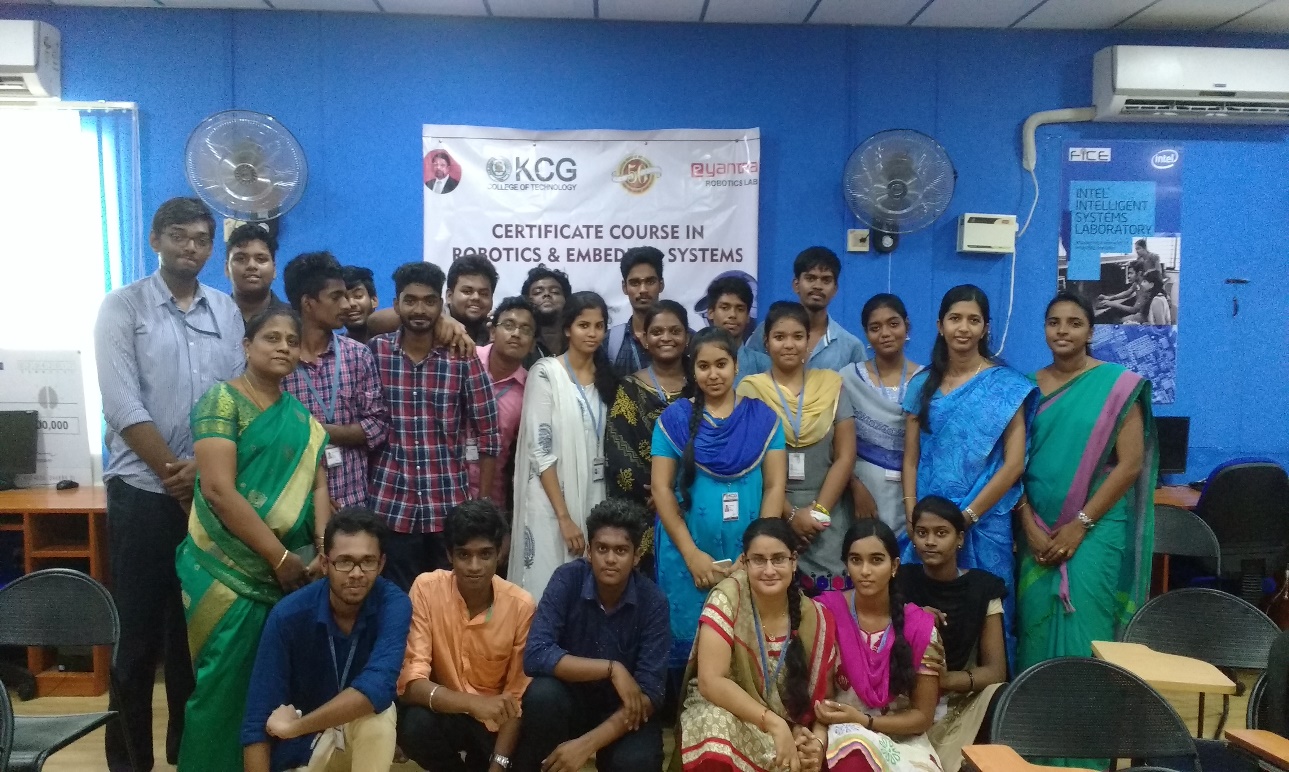
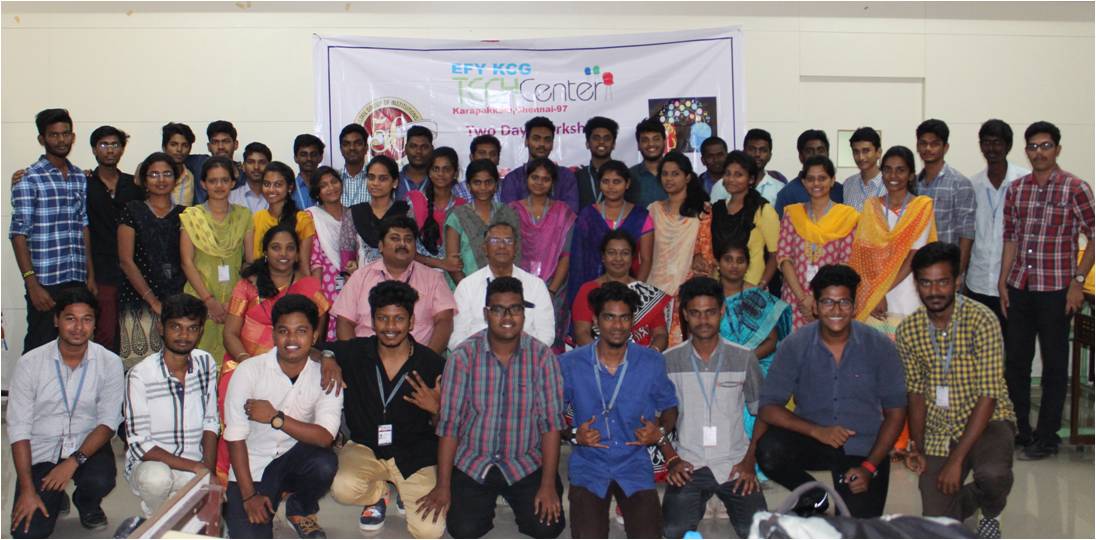
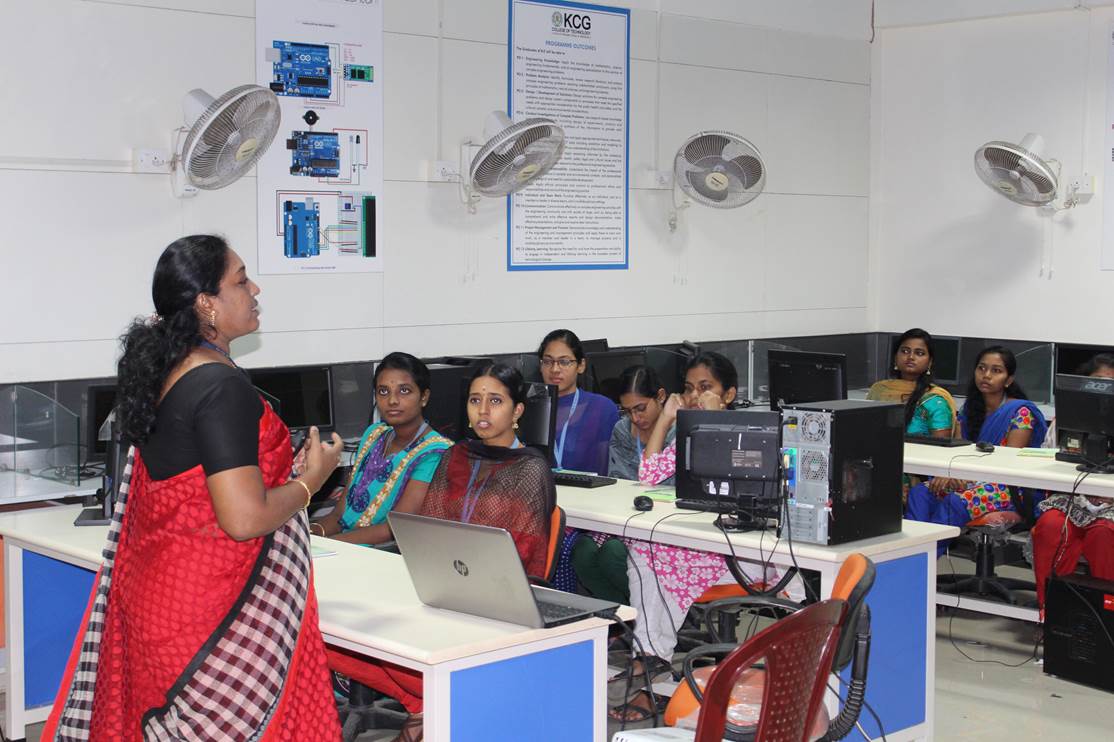
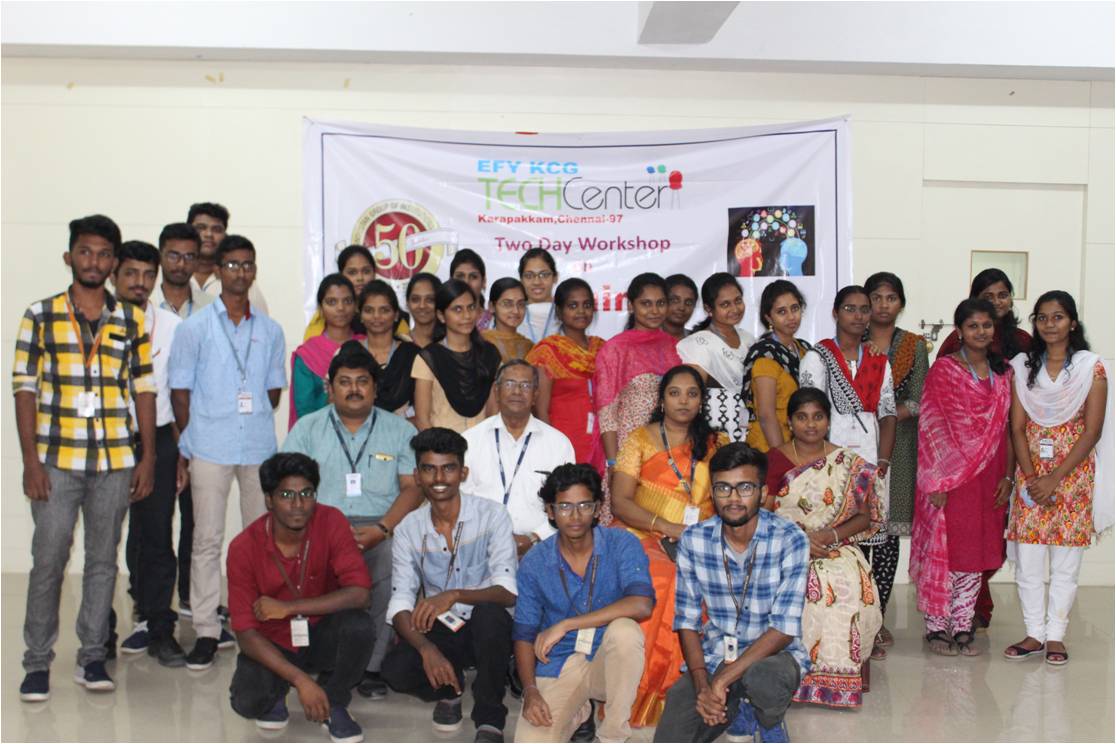
A two day workshop on ARDUINO was conducted by the core team of EFY KCG Tech center exclusively for students of ECE department on Thursday, 22 Dec 2017 and Friday, 23 Dec 2017.The program commenced at 9.00 am at the EFY LAB, Room No T61. The Chief Resource Person was Dr.V.Subbaroyan, Professor, ECE Department and he was well supported by the core team members of EFY KCG Tech Center, Ms.B.Thyla, Mr.T.Thomas Leonid and Ms.Jaraline Kirubavathy. 24 students attended the Program.Out of which 12 students were from EEE, 3 students from E&I,7 students from CSE and 2 students from IT department.
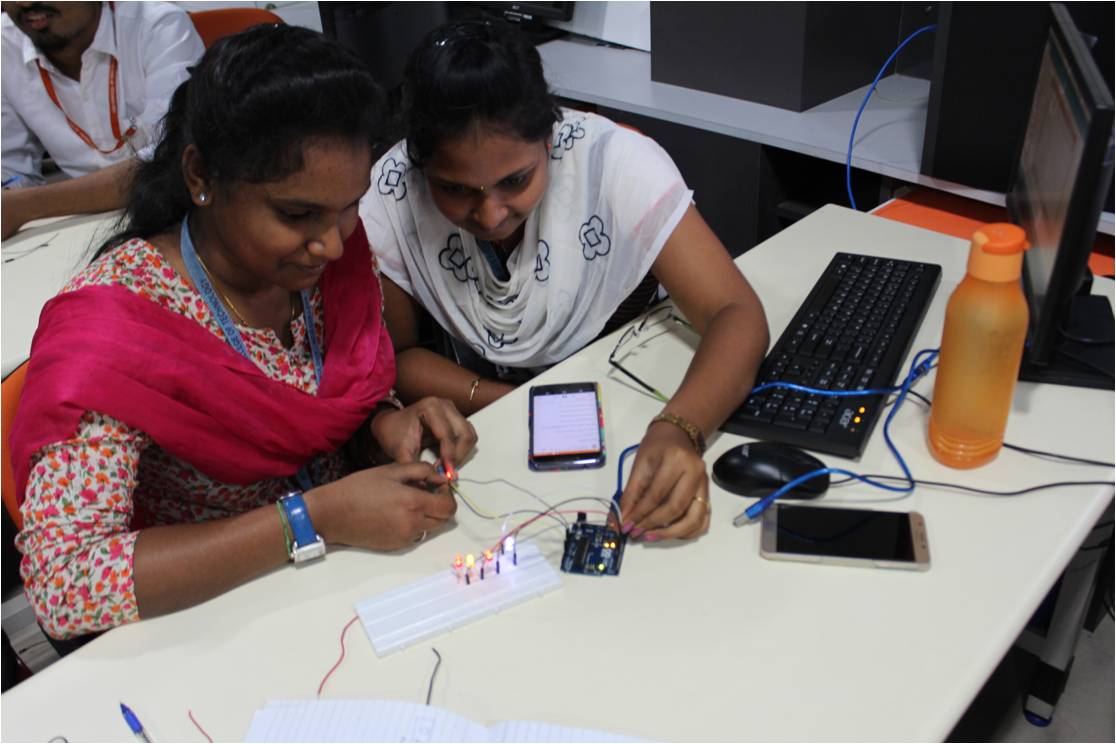
First session was introduction to the Arduino and how to start up with the tools. Arduino is and inexpensive, cross platform, simple and clear programming environment. After the Tea break at 10.40 am the next sessions on few sketches like LED blink and sequence of LED blink was outlined. Participants found few programs like LCD display, seven segment display and Bluetooth module very interesting and got involved in doing further programs. Many other fun filled projects were done by the participants in the afternoon session.
This workshop was organized to facilitate the student to effectively use ARDUINO software to undertake projects and research work. The sessions were completely hands on, increasing the confidence of the participants in using the tools and the trainers were adept at clarifying the questions that arose during the session relating theory concepts studied to practical issues.