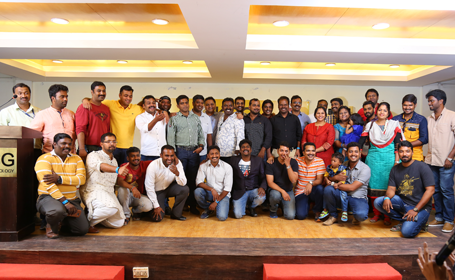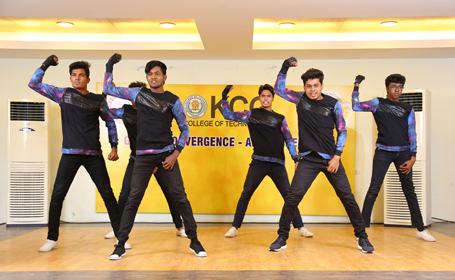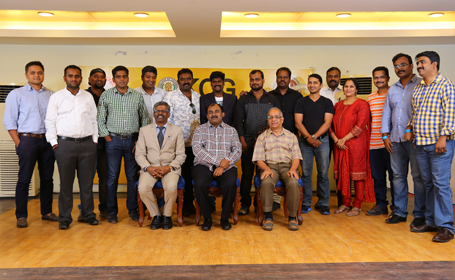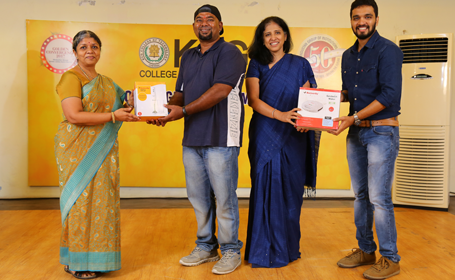

“The higher education system in the US is different from that of India and Indian students who seek admission in highly-competitive programs in American universities should prepare themselves well in order to achieve their goal,” said Shanthi Charath Mohan, Coordinator, EducationUSA, Unites States India Education Foundation (USIEF), at a day-long boot camp on higher education in the US, held at KCG College of Technology, Chennai. “Plagiarism will not be tolerated by American universities and therefore students learn to write everything, including their Statement of Purpose (SOP), on their own,” she added.
In his address, Principal Dr G Prabhakaran highlighted the need for pursuing higher studies and encouraged the students to prepare for competitive exams such as GRE, GATE, TOEFL and IELTS.
The boot camp focused on the five steps to US education: researching options and shortlisting universities, financing studies, completing the application, applying for a US student visa and preparing for departure to the US. The participants also had a workshop on how to write statement of purpose.
The Higher Education and the International Affairs cells of the college jointly organized the boot camp. Fifty students from various departments attended the program.

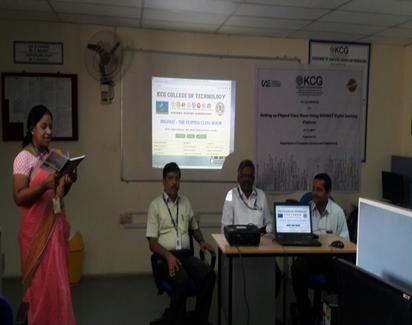
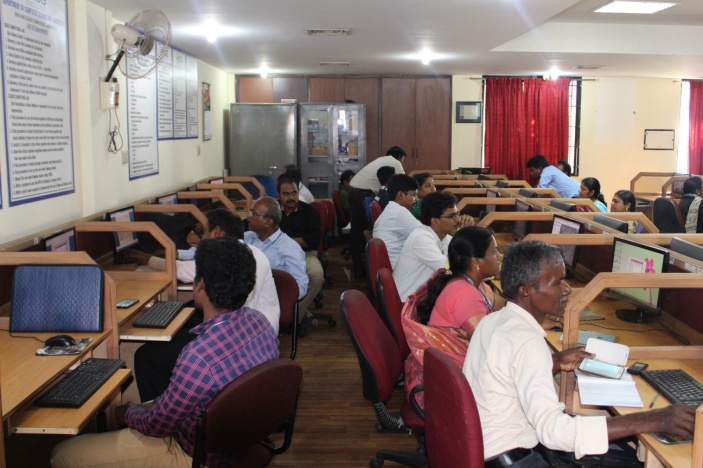
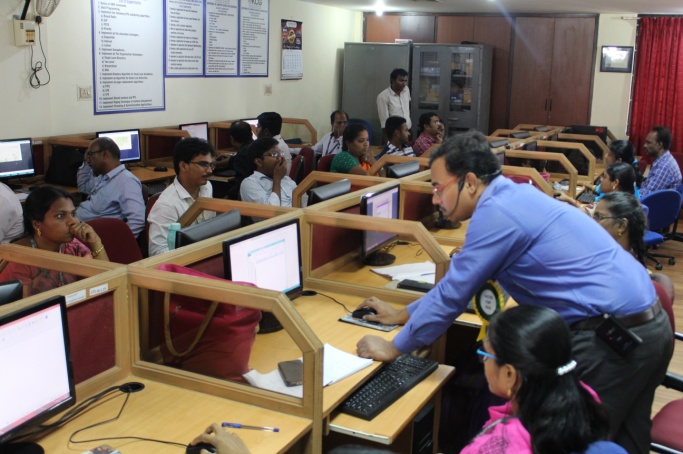
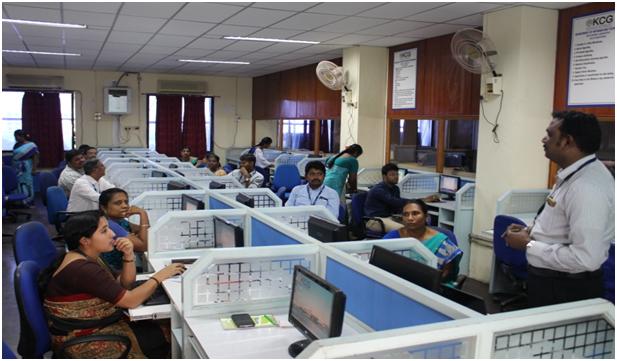
A Workshop on Setting up Flipped Class Room Using DIGIMAT –Digital Learning Platform was organized by the computer Science and Engineering, on November 17th, 2017 at M.E Lab. Twenty faculties of various disciplines, attended the workshop. The workshop was led by key resource person: Mr.Baskar Selavaraj,CEO of LinuXpert System,Chennai. The aim of the workshop was to enable the participants to familiar and work on the Digital resources and NPTEL videos on subjects in all the engineering disciplines.
The workshop began with a welcome address by Dr. M Krishnamurthy, HOD,Dept. of CSE, Principal Dr.G.Prabhakaran delivered the presidential address.Dr.P.Selvi Rajendran,Professor ,Dept.of CSE introduced the speaker. Then the speaker started the session. The complete sessions were organized as a Hands-on session and lecture
Feedback from Evaluation forms was extremely positive. The presentation and the inputs given by the resource persons were highly valued. Participants appreciated for being able to clarify doubts with the experts.
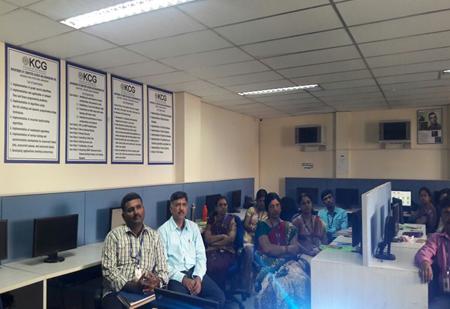
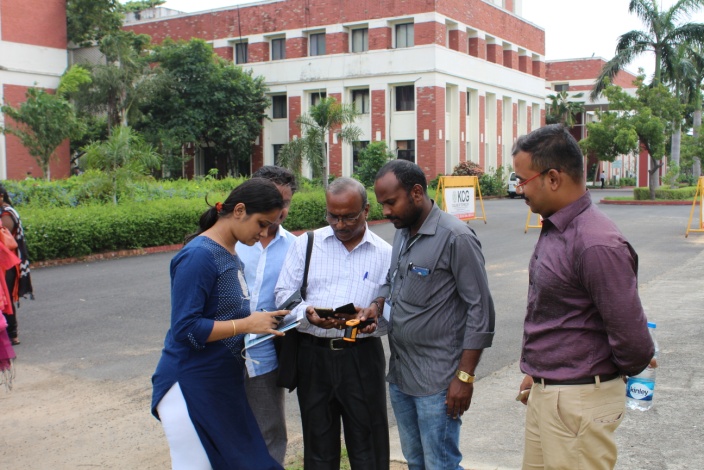
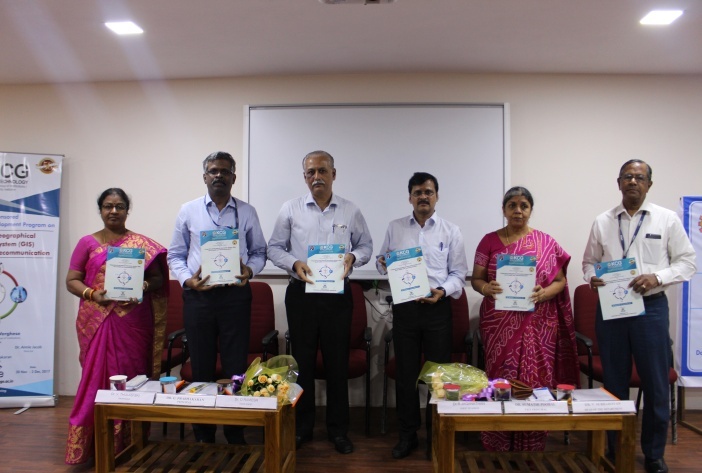
The two week Faculty Development Program on “Integrating Geographical Information System (GIS) into E-Health and Telecommunication” had been organized from 20 Nov 2017 to 03 Dec 2017. The Program was inaugurated by the chief guest Prof. N. Sivagnanam, Former Professor and Head, Department of Geography, University of Madras, Former Col.Colin Mackenzie Chair Professor, Anna University and the Guest of honor Prof. R. Jaganathan, Professor and Head Department of Geography, University of Madras, Chepauk, Chennai – 05. More than 60 participants from various colleges were registered for the program and it was shortlisted to 40 participants. The list of colleges who have participated in our program is listed below:
Priyadarshini Engineering College, Vaniyambadi, Tamil Nadu
Excel Engineering College, Tiruchengode, Tamil Nadu
TRP Engineering College,Irungalur, Tamil Nadu
Central Polytechnic College, Chennai, Tamil Nadu
Government Polytechnic College, Cheyyar, Tamil Nadu
Jeppiar Engineering College, Chennai, Tamil Nadu
Jeppiar Maamallan Engineering College, Chennai, Tamil Nadu
S.A. Engineering College, Chennai, Tamil Nadu
Sridevi Women’s Engineering College, Hyderabad, Andhra Pradesh
Jerusalem College of Engineering, Chennai, Tamil Nadu
Karunya University, Coimbatore
SRM University, Ramapuram, Tamil Nadu
SRM University, Kattankulathur, Tamil Nadu
University college of Engineering, Kanchipuram, Tamil Nadu
Anna University, Guindy, Chennai, Tamil Nadu
Dr.Sivanthi Aditanar College of Engineering, Tiruchendur, Tamil Nadu
University of Madras, Chennai, Tamil Nadu
Sathyabama University, Chennai, Tamil Nadu
Annamalai University, Chidambaram, Tamil Nadu
Experts from eminent universities delivered a technical talk and hand on experience in QGIS tool. The list of resource persons are listed below:
- Prof. R. Jaganathan
Professor and Head
Department of Geography
University of Madras
Chepauk, Chennai – 05
- Prof. N. Sivagnanam
Former Professor and Head, Department of Geography,
University of Madras
Former Col.Colin Mackenzie Chair Professor, Anna University,
Chennai.
- Dr. D. Surendran M.Sc., Ph.D.,
Guest Lecturer
Department of Geography
University of Madras
Chepauk, Chennai – 05
- Dr. P. Shoba, B.E., M.Tech., Ph.D.,
DST Inspire Fellowship Awardee,
Research Assistant Professor,
SRM University, Chennai
- K. Annaidasan M.Sc., (Ph.D.)
UGC-CPEPA Project Fellow
Department of Geography
University of Madras
Chepauk, Chennai – 05
- S. Stephen Jayaseelan M.Sc., M.Tech, M.Phil. (Ph.D.)
DST-PURSE Fellow
Department of Geography
University of Madras
Chepauk, Chennai – 05
- N. Manikandan M.Sc., M.Phil. (Ph.D.)
DST-PURSE Fellow
Department of Geography
University of Madras
Chepauk, Chennai – 05
- RupaRajanM.Sc., (Ph.D.)
University Research Fellow (URF)
Department of Geography
University of Madras
Chepauk, Chennai – 05
The program is conducted with the following seven major topics with hands on session.
Basics in GIS
GIS in Telecommunication
GIS in E-Health
Remote sensing basics and its applications
Pollution mapping
Web Mapping
Open Source Tools in Research
At the end of the program, all participants had learnt the open source tool QGIS, integrate GIS into E-Health, GIS into Telecommunication and how to do various research work with GIS.
Day 1 (21.11.2017):
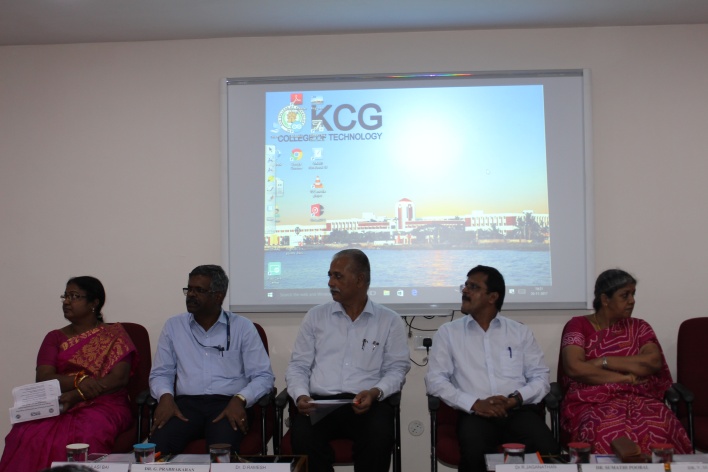
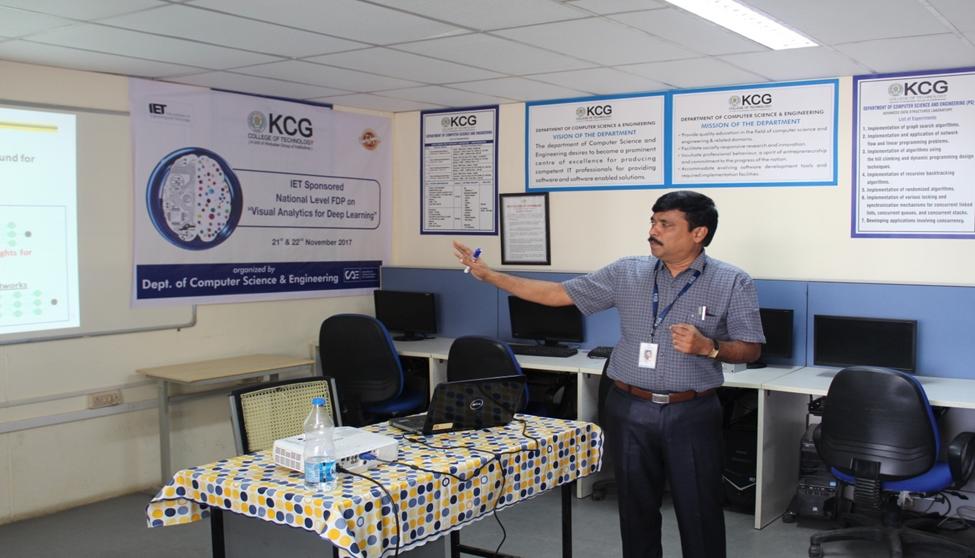
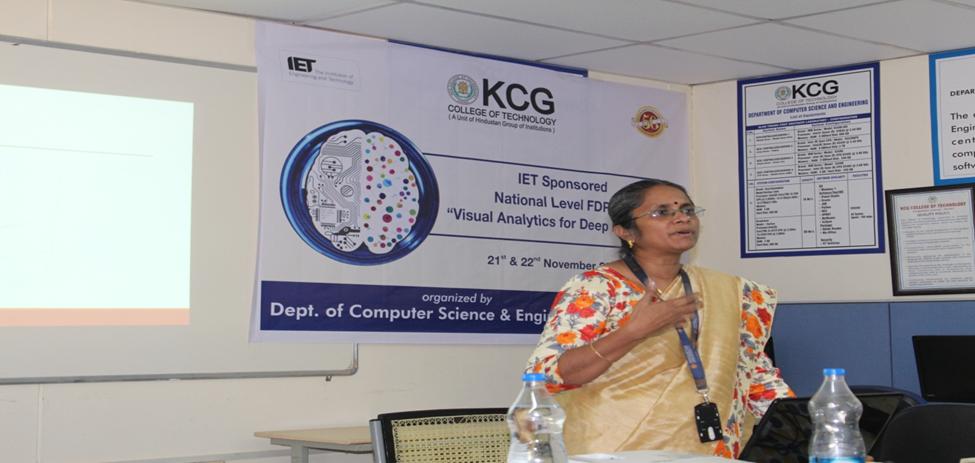
The FDP started with an inauguration by Dr.Angelina Geetha-Professor, Crescent University. She shared her academic experience in a wide variety of domains. Dr. Krishnamurthy, HOD of CSE delivered welcome address and Principal Dr.G.Prabhakaran gave presidential address and session was started for the day.
Session 1 : Deep Learning and Big Data Analytics
Speaker: Dr.Angelina Geetha, Professor – CSE Crescent University
Dr.Angelina Geetha gave a detailed introduction to what is data, information, knowledge and understanding. She also explained how analytics is different from analysis. She briefly introduced what Wisdom of things is and introduced data mining. She explained different machine learning methods like classification, clustering, association rule discovery, sequential rule discovery, regression and deviation detection. Her insight on Hadoop framework and Map reduce technique was very useful. She also explained the 4 types of analytics – descriptive, diagnostic, predictive and prescriptive. Her real time applications and examples made the session very interesting and concepts easy to understand. She introduced deep learning and how neural networks help in achieving deep learning. She explained multi-layer perceptron, training set data and testing set data in detail. She gave a quick overview of an open source tool called H2O for deep learning. The first session gave an awesome start for the 2 day workshop.
Session 2 : Machine Learning Algorithms and Commercial Applications.
Speakers: Mr Madhan U Srinivasan & Raghavan Subramanian, TechArtus Solutions
Mr.Madhan gave an insight on the difference between with programming and machine learning. He explained classification in detail with examples. Explained how neural networks. He explained the machine learning need in the healthcare domain and the practical challenges in developing solutions in this domain. He showed lot of videos to emphasis of machine learning for the current scenario. He opened up a lot of areas where we could start research work on. He gave an quick introduction to Tessarach a HP tool and other open source tool for machine learning. The second part of the session was handled by Mr.Raghavan, founder of TechArtus Solutions, Chennai. He gave a detail insight on Simiyin their proprietary tool for machine learning. A Live demo regarding prediction of stock market was very useful.
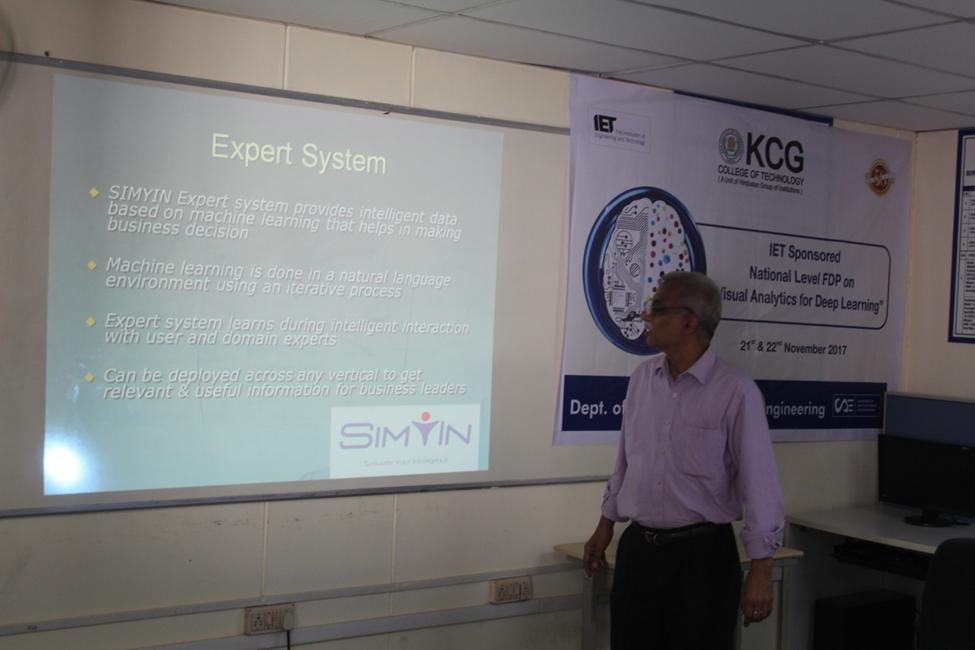
Day 2(22.11.2017):
Session 1: Visualisation in Deep Learning
Speaker: Mr.Dhanasekar Paneerselva-Senior Lead, HCL technologies
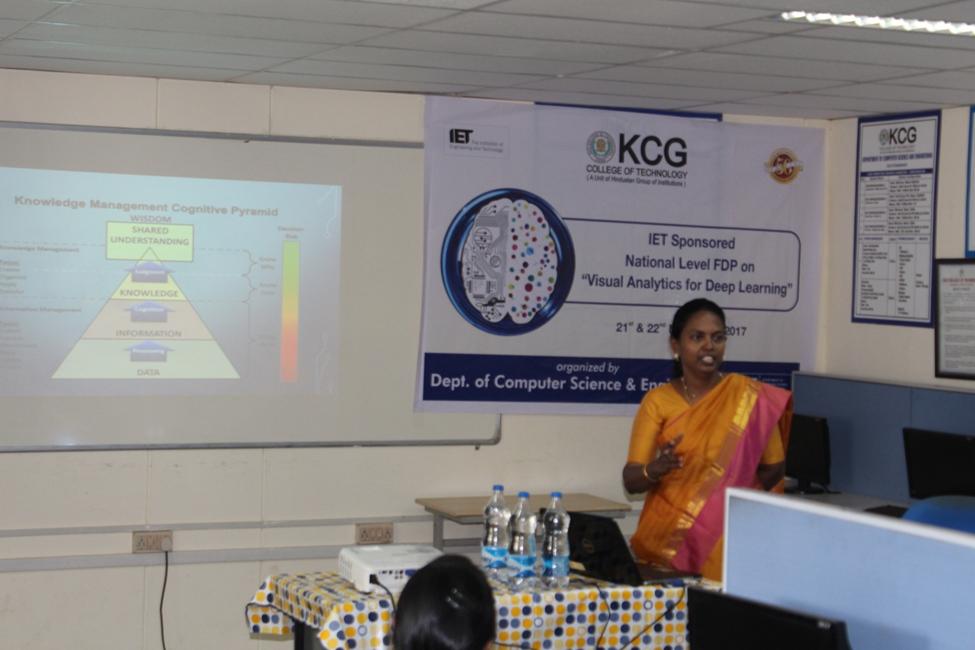
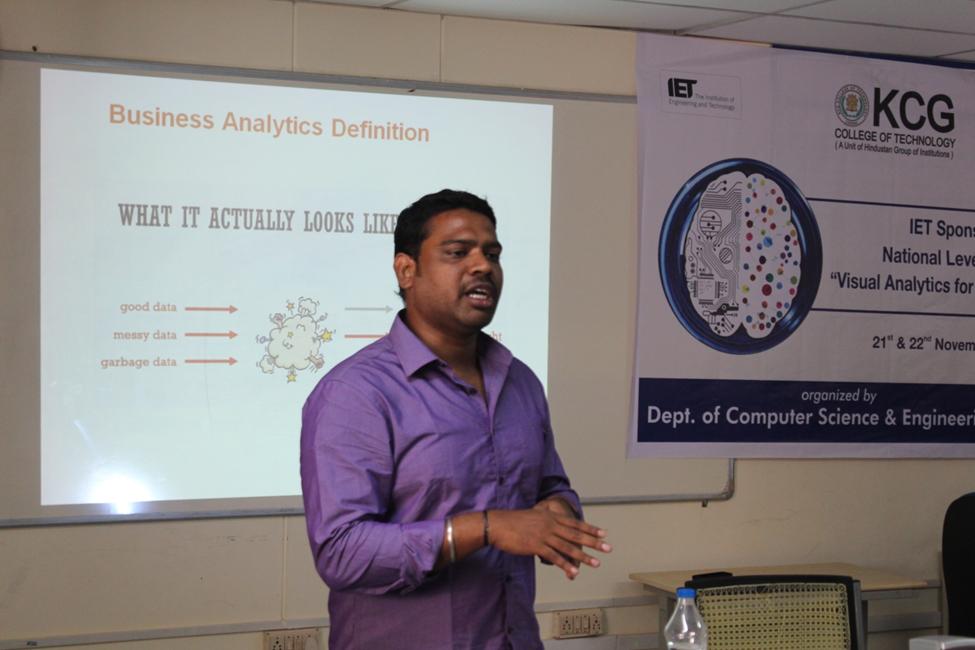
Mr.Dhanasekar Paneerselvam was the keynote speaker on the Topic. He gave a detailed insight on Business Analytics, Data Analytics and its types. He explained the Analytic process, Analytical examples and challenges. He also gave a detailed insight on the topic through a case study on Google Analytics. He guided us with the tools that will help in data analytics. Then he focused on what is visualization and what is visual analytics. He explained visual analytics model and detailed the importance of data visualization. This session was indeed very useful and informative on how data analytics is used practically used in so many areas.
Session 2: Deep Learning in Neural Networks
Speaker: Dr.Krishnamurthy, HOD of CSE department, KCG College of Technology
Dr.Krishnamurthy gave introduction on Neural Network and how multilayered architecture helps in deep learning. He had a very interactive and interesting talk about single,2 and 3 tier architecture and explained in detail how multilayer architecture helps in refining data. He also explained about feed forward and back propagation. He explained how the hidden layers satisfy the unsupervised learning of deep learning. He explained the difference and significance of training data and test data. He also gave a example problem to understand how weights of the edges influence in the output calculation. Overall this was the most interactive session.
Session 3: Deep Learning with Tensorflow
Speaker: Mr.Robert Jean, Senior Embedded Engineer, Vistronics Design Solutions
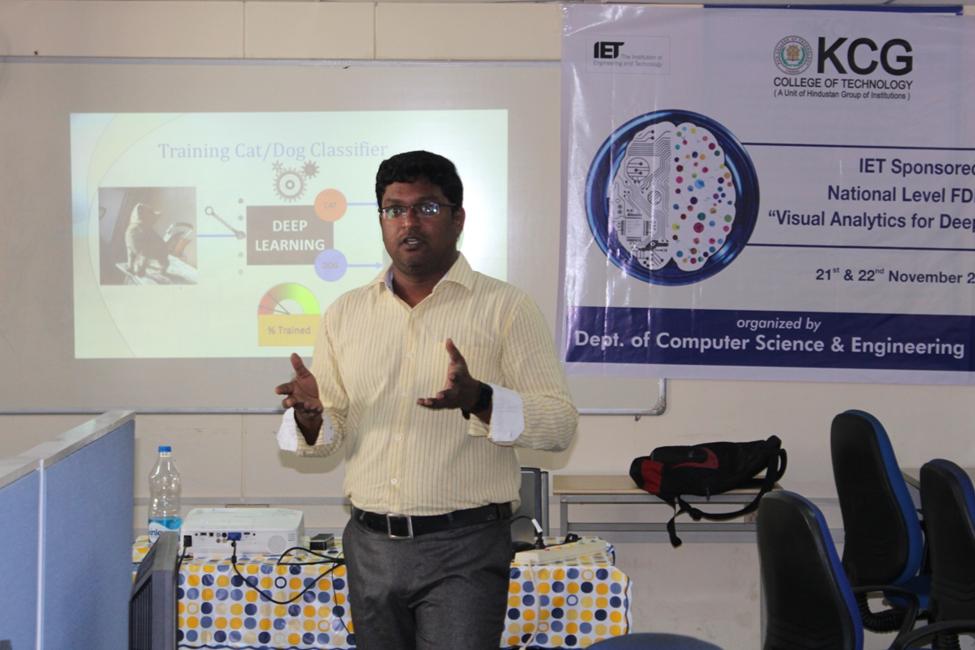
Mr.Robert Jean gave quick technical theory introduction to deep learning through the usual Cat/Dog Classifier. He explained about back propagation and how training data is important for better results. Tensorflow is an ope source tool developed by Google to write our own deep learning algorithms. Mr.Robert helped us install the tensor flow so that we can have an hands on. But since we did not have the right installable, we could do it. So he has a live demo of a sample program in python to implement a deep learning algorithm. Audiences were excited to get his guidance on how to write, execute and visualize the graph.
Session 4: Domain Specific Applications of Visual Analysis of Deep Neural Networks.
Speaker: Dr.S.Sathyalakshmi, Professor of CSE, HITS
Dr.S.Sathyalakshmi gave different areas where deep learning has a great future. She gave details on different areas like visual sentiment analysis, Colorization of black and white photo, Automatic machine translation, Object classification and detection, Automatic Handwriting Generation, Automatic Image Caption Generation and Automatic text generation. This session was useful as it gave an insight so that we can chose our areas of interest and do our future research.
One day Faculty Development Programme on “MATLAB PROGRAMMING WITH ADVANCED TOOL BOXES” was organized by the Department of Electrical and Electronics Engineering with an intention to upgrade the knowledge in MATLAB Programming with the aid of advanced tool boxes. The training programme was organized by Dr. P. S. Mayurappriyan and the resource persons were Mr. Kazi Yaser Arafat S & Mr. Balaji, Application Engineers, Design Tech Systems, Chennai and the event was co-ordinated by Ms. M. Ammal Dhanalakshmi.
The morning session started at 11.00 a.m. with a brief introduction to MATLAB 2017b which is the latest version to be introduced in the market. The trainer focused on key aspects of MATLAB – Automation in Technical Computation and the pre–requisite platforms essential for the operation. The programme continued with the basic script file and function file codings with advanced features. Further, there was a brief presentation on tool boxes like graphical user interface design and Embedded C coder.
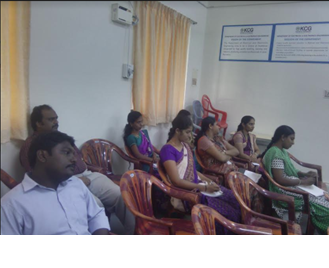
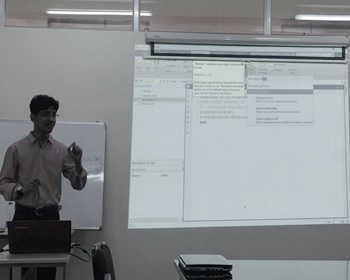
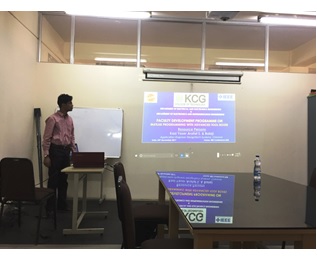
The post lunch session commenced with real time image processing techniques using external camera interface and various Simulink models with automatic tuning features. This was followed by a demonstration of external controller interface like ARDUINO UNO with MATLAB, wherein the device was controlled through MATLAB simulation. In addition, the M File that was generated in MATLAB was converted to an executable C file for further usage. Another important feature of MATLAB 2017b version was automatic generation of a report and power point presentation from an M File or a Simulink model on successful compilation of the programme. The session came to an end with IoT based MATLAB techniques at 4.10 pm. The participants in their feedback expressed that the entire session was effective and interactive to enable them to continue their research work with MATLAB advanced tool boxes.
Coordinator
Mr.M. Baskar
Assistant Professor-Selection Grade
Department of Information Technology
KCG College of Technology
Resource Person
Mr. T. Rajendran
Assistant Professor-Selection Grade
Department of Computer Science and Engineering
GRT Institute of Engineering and Technology
About Workshop
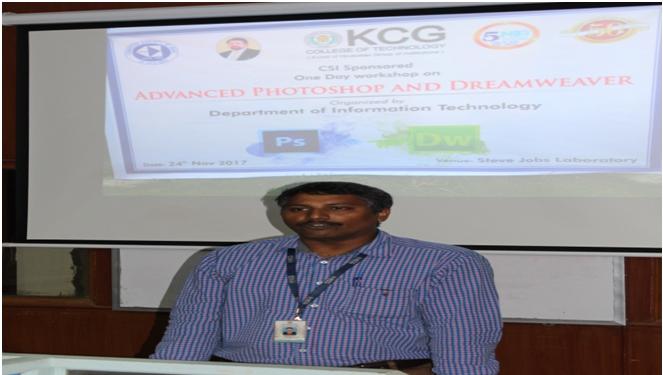
Photoshop is a tool which has taken pivotal position in everyone’s life now a day. A fair bit of knowledge about the software is quintessential. The department of Information Technology has taken the pioneering step in conducting a programme on the Photoshop which will enable the attendees to address different issues ranging from photo editing to brochure designing.
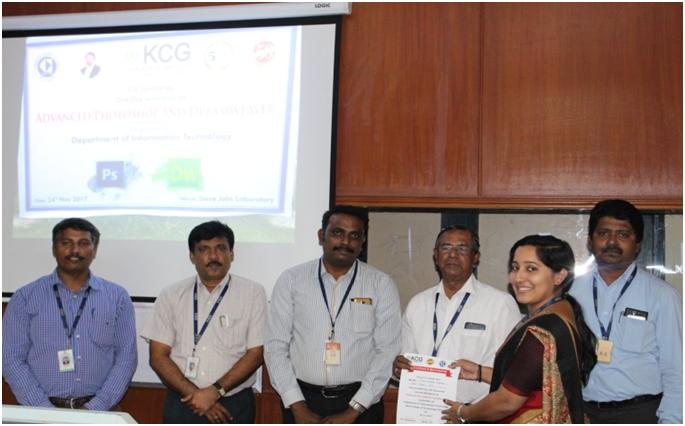
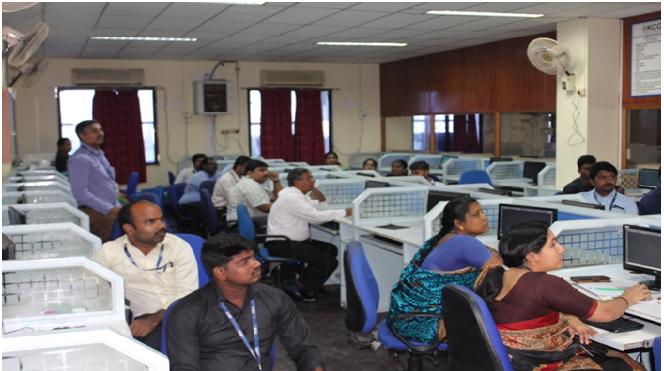
The program started with the inaugural function at 9.00 A.M . Dr. Sumathi Poobal, Vice Principal, KCG College of Technology was the chief guest. She appreciated the Department for organizing such a workshop, which was indeed the need of the hour. The Head of Department, Dr. J. Frank Vijay underscored on the importance of such a programme and suggested that the idea for such a workshop came from the dependency the faculty members are showing on the students even for simplest editing jobs like designing brochures and other related items for departmental programmes and activities. He insisted the resource person to conduct the workshop in such a way where hands on experience is imparted, and inevitably after the completion of the workshop, all the faculty members who have attended the programme should be able to design a brochure by themselves.
The training session started by 9:30 A.M. Mr. Rajendran, an expert in Photoshop and Dreamweaver, and having years of vital experience set the ball rolling. His technical know-how and software prowess impressed the attendees and evidently underscored the fact in ever one’s mind that he is the right person to lead the workshop. The Photoshop section was covered in the morning session and was followed by the session on Dreamweaver in the afternoon. The portions covered broadly include:
Topics Covered
PHOTOSHOP
- Photoshop Workspace
- Photoshop Basics
- Selections in Photoshop: Isolating Editing
- Painting and Retouching
- Color Manipulation
- Working with Layers
DREAMWEAVER
- Dreamweaver Workspace
- Working With Flash Menus and Buttons
- Design and Publish a Web Page
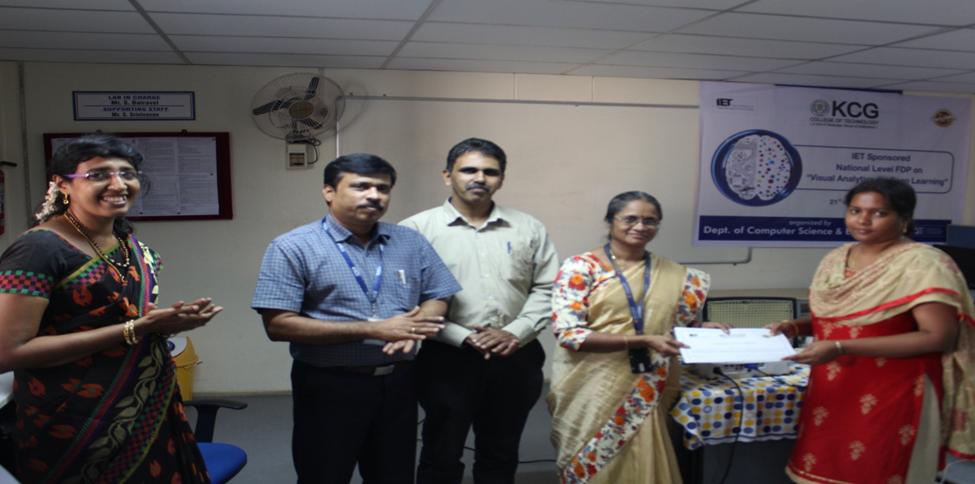
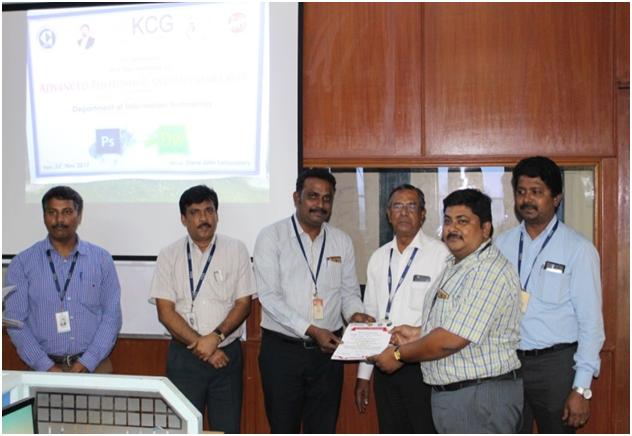
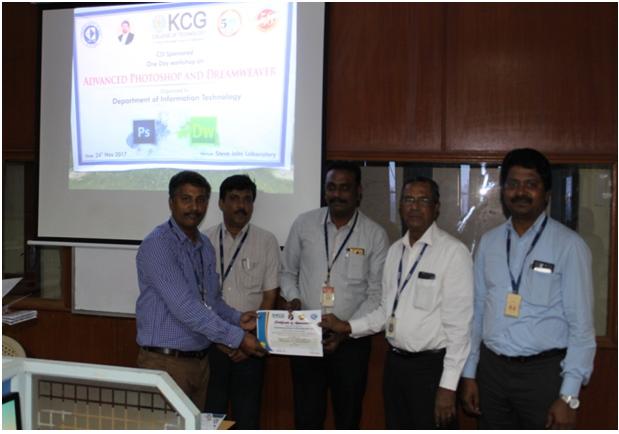
The workshop was really interesting and informative. The 28 faculty members from other departments including the heads of other departments also attended the workshop. The workshop came to an end with the valedictory function. The certificates for all the participants were distributed, marking the end to another successful programme by the department of Information Technology. Finally, Vote of Thanks is given by the program coordinator Mr.M.Baskar, Assistant Professor –Selection Grade, Dept. of IT.
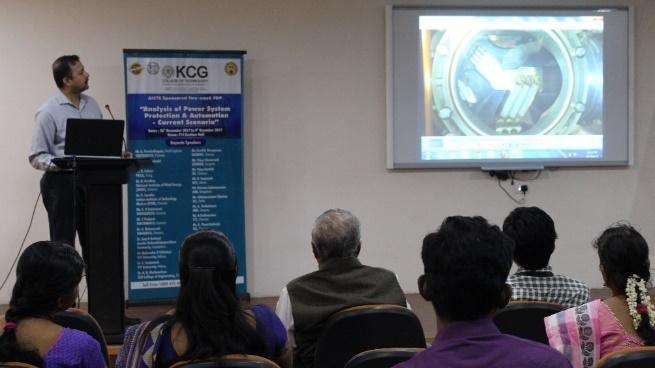
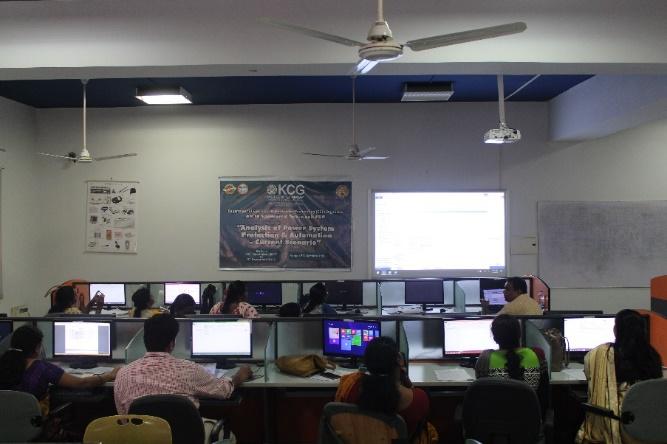
The Department of Electrical and Electronics Engineering, KCG College of Technology organized Two Week Faculty Development Programme on Analysis of Power System Protection And Automation- Current Scenario from 26th November – 9th December, 2017.
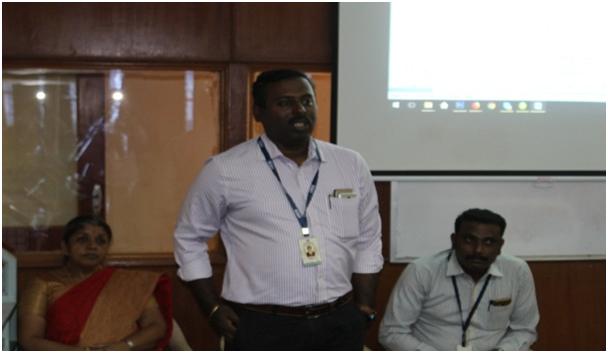
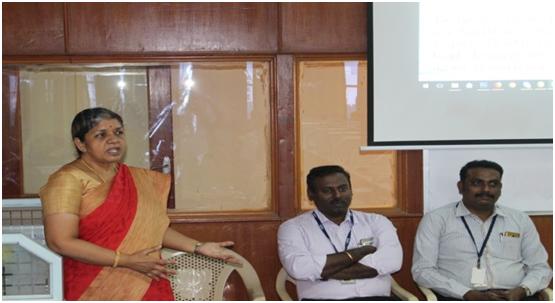
The inaugural function commenced at 9.00 am in Seminar Hall-I. The meeting began with an invocation and welcome address by Dr. P. DeivaSundari, Professor & Head, Department of EEE. The The meeting was presided by Dr. G. Prabhakaran, Principal. He congratulated the Department of EEE for hosting such FDPs in association with industries and offered his felicitations. Dr. G. Sambandan, Advisor – Electrical Sciences also addressed the gathering stating the significance of the topic in current scenario. Around 65 participants registered for the programme.The participants mostly were Faculty and Research Scholars from major academic institutions in and around Tamilnadu.
The programme was inaugurated by the Chief Guest, Mr A. Panchalingam, Chief Engineer, Protection and Communication, Tamilnadu Transmission Corporation Limited (TANTRANSCO), Chennai. He shared his views regarding basic protection schemes and recent advancements in protection. He also enlightenened the gathering with the concept of digital substation. The guest of honour, Mr. Balaji Seshadri, Lead Commissioning Specialist, General Electric, Chennai shared his views on power sector growth.
Day 1
Date: 26.11.2017
Session I & II: Power Protection Test Equipment Demo
Venue: Seminar Hall (F14)
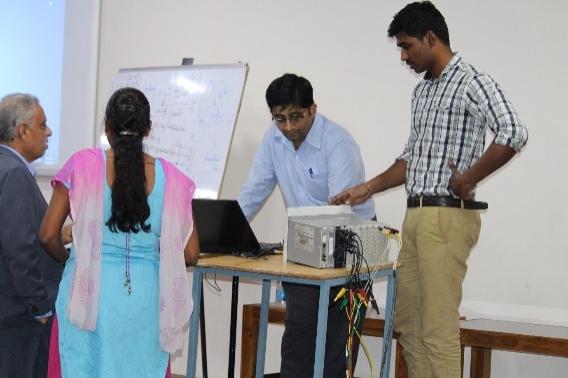
The fundamentals of Power System Protection, and transformer differential protection was discussed in detail. Differential protection of transformer using P642 numerical relay and OMICRON was demonstrated to the participants.
Day 2
Date: 27.11.2017
Session I: Fundamentals of Power System Protection
Speaker: Dr.Mahendra V Chilukuri, Associate Professor, School of Electrical Engineering, VIT University, Vellore
Venue: Seminar Hall (F14)
Dr.Chilukuri discussed the various protection characterstics and protection zones in power system. He explained the various types of protection relays. He showed the practical aspects of protection with a comparative study in Malaysian power system.
Session II: Main and Back-up Protection
Speaker: Dr.Mahendra V Chilukuri, Associate Professor, School of Electrical Engineering, VIT University,Vellore
Venue: Seminar Hall (F14)
The session started with the basics of current transformer and potential transformer highlighting the various protection related terms like CT error, CT saturation. The session continued with optical instrument transducer.
Session III: Grid Transformers Protection
Speaker: Dr.Mahendra V Chilukuri, Associate Professor, School of Electrical Engineering, VIT University, Vellore
Venue: Seminar Hall (F14)
The speaker had discussion on various relay characteristics and working of various types of relays. He explained in detail the working of static relays, numerical relays and features of relays used in protection of grid transformers.
Day 3
Date: 28.11.2017
Session I: Transformer, Generator and Motor Protection
Speaker: Dr.Mahendra V Chilukuri, Associate Professor, School of Electrical Engineering, VIT University, Vellore
Venue: Seminar Hall (F14)
The session started with principles of unit protection. He explained in detail the biased differential current relay for the protection of generators and motors. He emphasised on transformer inrush phenomenon. The conditional monitoring of transformers which is one of the recent key research areas in power systems was also discussed.
Session II: Condition Monitoring and Asset Management – Partial Discharge Diagnosis Technique for Offline & Online Analysis
Speaker: Dr.S.Venkatesh Associate Professor, School of Electrical Engineering, VIT University, Vellore
Venue: Seminar Hall (F14)
Dr.S.Venkatesh discussed the importance of condition monitoring and asset management, the need for power engineers in this area for further research. The session also dealt with the need of testing of power apparatus. The discussion continued with basic principles of Partial Discharge (PD) and various voltage and current PD waveforms. The principle of Partial Discharge Detection Circuits and PD Analyser was also discussed.
Session III: Electric Arc Flash Analysis.
Speaker:Dr.Mahendra V Chilukuri, Associate Professor, School of Electrical Engineering, VIT University, Vellore
Venue: Seminar Hall (F14)
The session stared with basics of arc-flash phenomenon, its characteristics and the effects of arc-flash that lead to switchgear damage. The speaker also dealt with arc -lash measurement techniques and calculations. A case study on arc-flash helped the participants to have a practical exposure on arc-flash techniques.
Session IV: Non-intrusive Testing Techniques for Ageing/ Residual Life Assessment of Power Equipment Conventional & Non Conventional Approaches
Speaker: Dr.S.Venkatesh, Associate Professor, School of Electrical Engineering, VIT University
Venue: Seminar Hall (F14)
He enlightened the audience with the Electric Treeing and the Testing of PD Test Setup. He showed photographs of laboratory studies conducted at LIT- University of Bologna. Variety of analysis techniques applied on the data to extract characteristic information of PD was also discussed. The session continued with the discussion on classifiers for multiple source PD pattern recognition and types of on-line PD measurement system challenges related to online PD analysis.
Day 4
Date: 29.11.2017
Session I: Network Planning Using Advanced Power System Simulation Tool (Siemens Software)
Speaker: Mr. Vikas Chaturvedi, Maintenance and Support, Siemens, Gurgaon.
Venue: Seminar Hall (F14)
The session dealt with PSSE, the transmission planning software from Siemens. The challenges in expansion, operation, regulatory compliance, system reliability and security were discussed. Hosting capacity calculation, distribution network analysis by PSSSINCAL was discussed. The features along with the add on modules of the software was dealt in detail.
Session II: HVDC
Speaker: Dr. Mahendra V. Chilukuri, Associate Professor, School of Electrical Engineering, VIT University, Vellore
Venue: Seminar Hall (F14)
He discussed in detail the aspects of HVDC Technology. A comparative study of AC & DC Transmission and detailed discussion on worldwide HVDC links along with a schematic presentation of HVDC transmission system was done. This was followed by an informative session on HVDC applications in India. A schematic diagram of Converter Station was presented in the session.
Day 5
Date: 30.11.2017- Field Trip to Indira Gandhi Centre for Atomic Research (IGCAR), Kalpakkam.
A visit to Simulating and Training Centre, Fast Breeder Test Reactor at IGCAR was made. At simulating centre, the entire process was simulated using C and Fortran and the mock control panel has been created for training the operators. This centre simulates the control panel of 500 MW Prototype Fast Breeder Reactor.
The Fast Breeder Test Reactor (FBTR) is a breeder reactor of 40 MW capacity. The Indira Gandhi Center for Atomic Research (IGCAR) and Bhabha Atomic Research Centre (BARC) jointly designed, constructed and operate the reactor. The reactor was designed to produce 40 MW of thermal power and 13.2 MW of electrical power. It is called Stage-II reactor because its fuel plutonium carbide is extracted from irradiated fuel from MAPS (Madras Atomic Power Station) reactors, which in turn called Stage-I reactors, whose main fuel is Uranium 235 and Uranium 238.
Day 6
Date: 01.12.2017
Session I: Grid Integration of Renewable energy and related Issues
Speaker: Dr. Sasi K Kottayil, Professor, Electrical and Electronics Engineering, Amrita VishwaVidhyapeetham University, Coimbatore.
Venue: Seminar Hall (F14)
The session started with discussion on net metering system with small grid-tied PV without storage and PV with dual mode inverter and storage. The various aspects of medium and large sized grid connected PV system and RE based smart micro grid was dealt in the session. The various wind turbine driven electrical machines like wind turbine driven squirrel cage induction generators, permanent magnet synchronous generators and variable speed induction generators was emphasized in the session. A new concept of smart solution for energy storage and demand dispatch was also given.
Session II : Issues & Control of Grid integrated Renewable Energy Systems
Speaker: Mr. Prasun Kumar Das Assistant Director, NIWE, Chennai
Venue: Seminar Hall (F14)
He emphasized on concepts of Solar Radiation Resource Assessment (SRRA) and gave a schematic representation of typical SRRA station. The basic principle of solar cell principle, losses in solar cell and different types of solar modules and its characteristics were discussed in the session. Latest topics of research such as losses in grid connected system and grid integration issues also were discussed.
Session III : UHV Transmission
Speaker: Dr.R.Sarathi, Professor, Department of Electrical Engineering, IITM, Chennai
Venue: Seminar Hall (F14)
The session started with need for UHV transmission system and the various challenges in UHV AC system. He dealt in detail the various Temporary Over Voltages (TOV), Slow Front or Switching Over Voltages (SFOV), Fast Front Over Voltages (Lightning Over Voltages) and Very Fast Transient Over Voltages (VFTO). The general principle of insulation coordination and various methods of determination of the system voltage stress were discussed under insulation coordination.
Day 7
Date: 02.12.2017
Session I: Overview of Blackouts – Lessons to be Learnt
Speaker: Dr. G. Sambandan, Advisor-Electrical Sciences, KCG College of Technology
Venue: Seminar Hall (F14)
The session dealt with the overview of blackouts, major global blackouts, blackouts in India, the twelve biggest blackouts in history, the reasons for blackouts and the lessons to be learnt. The session was stimulating with questions from participants and the real time examples that Dr.G.Sambandan shared from his experience.
The Department of EIE, KCG College of Technology Conducted Two Days Seminar on “Recent Trends in Biomedical Image Processing” on 29th and 30th November 2017. The Programme started with Inauguration on November 29th 2017. Dr.N.Bharathi , Head of the Department (EIE) and Convener of the Seminar gave the Welcome address. Dr.G.Prabhakaran, Principal, and Dr. Sumathi Poobal, Vice Principal, KCG College of Technology gave felicitation address. Dr.A.K.Jayanthy, Professor-Department of Biomedical Engineering, Kattankulathur Campus, SRM University inaugurated the session and gave inaugural talk. The inaugural session came to an end with the vote of thanks by Ms.Sunetra Banerjee.
(i). “Biomedical Optical Imaging” by Dr. A.K. Jayanthy, Professor, Dept of BME, SRM University, Katankulathur Campus
Dr. A.K Jayanthy started the first session with a brief introduction about Fluorescent Imaging techniques and Laser Speckle Contrast Imaging (LSCI) . Later she gave a detailed lecture on each topic like light sources, advantages of the techniques and its application in LSCI. She presented her case study on Psoriasis and Diabetic ulcers. She showed how optical imaging helped in diagniostic accuracy and specificity when compared to other imaging techniques with clear examples and its results. She also made a note that still optical imaging though promising diagnostic tool has very few people taken up their research in this area and she welcomed aspirants to pursue their research in optical imaging.
(ii) “MRI Brain Image Analysis” by Dr.M.Kayalvizhi, HOD- BME Dpt, Agni College of Technology,Thalambur.
Dr.M.Kayalvizhi started session-II with the basics of MRI brain imaging techniques. She explained the two types of MRI images namely T1 weighted images and T2 weighted images and its anatomical planes. She also explained about the need of skull stripping, various trigonometric parameters use in
the processing of MRI images and its algorithms. Finally the session ended up with the case study of various MRI brain images and its image processing algorithm results using K-Means clustering.
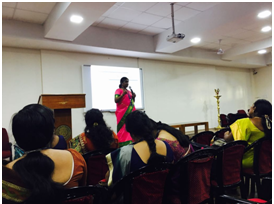
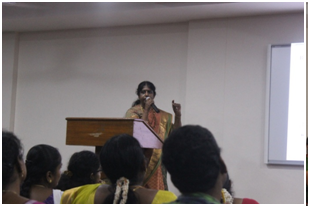
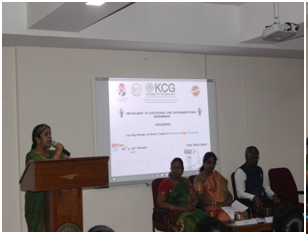
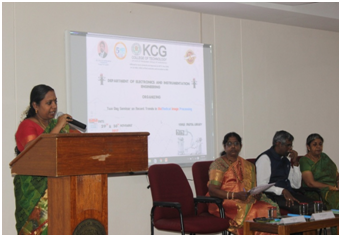
(iii). “Medical Image Analysis Using MATLAB” by Mr.J.Saminathan, Teaching Fellow, Dep. Of ECE, College of Engineering, Guindy
Mr.J.Saminathan started session-III with a brief introduction to various imaging modalities. He then explained various image processing techniques like image acquisition, image pre-processing, image segmentation, image enhancement, feature extraction and classification in MATLAB with various examples. He also explained why we go for gray scale images for image processing when compared to RGB image. He finally demonstrated all the above said techniques with the case study of detection of Lung Cancer using CT images.
(iv). “Imaging Science- An Overview” by Prof. S. Panneer Selvam , Associate Professor Of Medical Physics & RSO,Radiology and Imaging Sciences, Sri Ramachandra Medical College.
The second day of the seminar started with a talk by Professor Panneer Selvam. He started the session with the basics of imaging. He explained the science and Instrumentation behind all the imaging modalities like X-Ray, sonogram, CT, MRI, PET and Nuclear Imaging. He also made the audience understand how the image processing techniques help in improving the image quality in computer aided diagnostics. He also emphasized on the research avenues in this area in India and abroad.
(v) “Recent Advances in Diagnostic Radiology” by Dr. Balaji Jeevanandam, Asst.Professor, Radiology and Imaging Sciences, Sri Ramachandra Medical College.
Dr.Balaji Jeevanandam presented his talk on Recent Advances in Diagnostic Radiology. He shared his experience and views on various techniques in 3D image reconstruction like surface rendering and volume rendering. He explained with various sample images that how 3D image processing techniques help doctors in diagnosing abnormalities in certain crucial cases which 2D image processing technique could not accomplish.
(vi) “Thermography – A Promising Diagnostic Tool” by Dr.Sheeja.V.Franics Associate Professor, Department of ECE,MNM Jain College.
Dr. Sheeja.V.Francis focused on Thermography. She started the session with the basics of thermal imaging and its need as a diagnostic tool. She explained the role of thermal imaging in breast cancer diagnostics. She created awareness that though Mammogram is the conventional diagnostic tool for breast cancer and considered as the golden standard could not help in early diagnosis of breast cancer and also the painful procedure that the patients have to undergo even for screening purposes. Thermal imaging and its processing techniques on the other side though not accepted as a golden standard could help in early diagnosis. She clearly explained the above said point with images and results.
The Seminar came to an end with delivery of certificates to the participants and Valedictory.
As part of the Golden Jubilee celebrations of the Hindustan Group of Institutions (HGI), the alumni of KCG College of Technology, a Unit of HGI, had their mega alumni reunion on Saturday, 2nd December 2017. Over 350 alumni from different batches assembled at the college and celebrated their reunion.
Mr Gowri Shankar, Joint Secretary of KCG Connect which is the alumni network of KCG College of Technology, briefed the activities of the alumni network and its goal to start KCG alumni chapters across the globe. He also stated that KCG Connect had been giving support to the student community and had been raising funds for various social causes.
Dr Anand Jacob Verghese, CEO, Hindustan Group of Institutions, facilitated the alumni and said that the college had scripted many success stories and reached important milestones in the past decade and had been in the forefront of technical education and innovation. Expressing his admiration for the good work the alumni have been doing, he invited them to associate themselves with the activities of the college in the form of mentoring and assisting in placement and contribute to the growth of the institution and thus to the society at large.
Principal Dr G Prabhakaran, Vice-Principal Dr Sumathi Poobal, former Vice-Principal Dr Uduppa, Heads of Departments and faculty were present at the event.